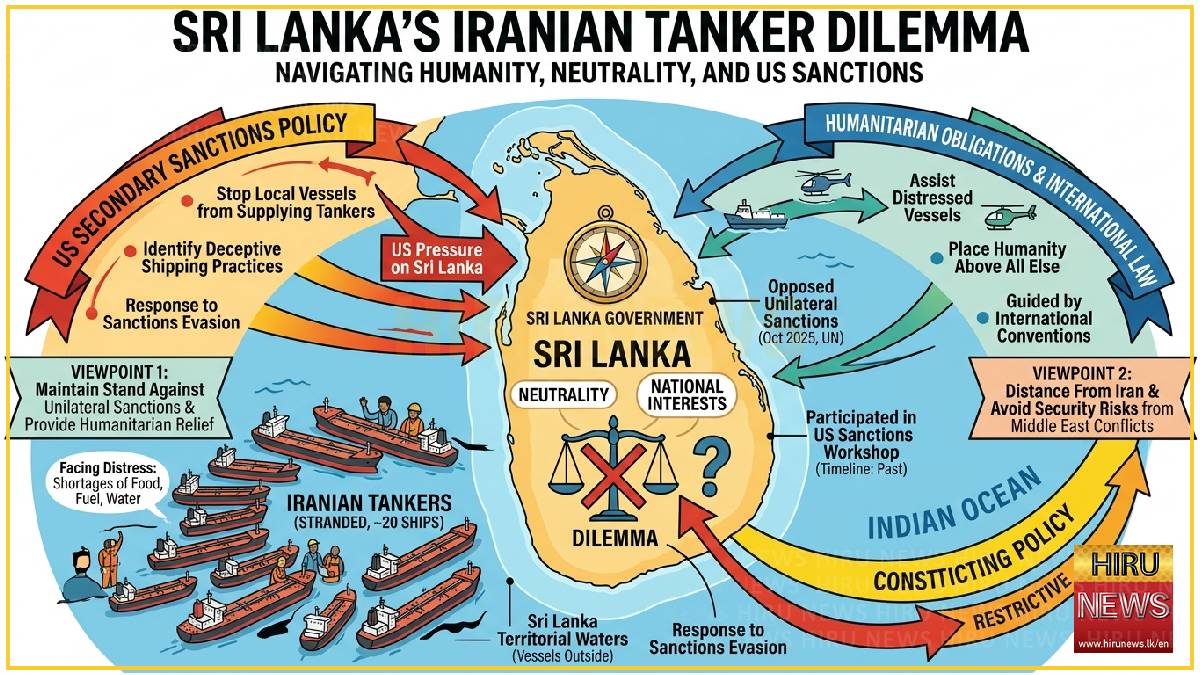
Sri Lanka is facing a delicate diplomatic dilemma over around 20 Iranian oil tankers stranded off its southwestern coast, with former diplomat Dr Dayan Jayatilleka calling on the government to put humanitarian obligations ahead of concerns over US secondary sanctions.
A Wall Street Journal report said the tankers were stranded roughly 15 miles off Sri Lanka and that several were facing shortages of food, fuel and fresh water amid tightening US sanctions and maritime restrictions.
The report stated US officials had in recent weeks pressed Sri Lankan authorities to prevent local vessels from supplying the tankers and their crews, citing Sri Lankan government documents and companies involved in supplying the vessels.
The vessels are currently outside Sri Lanka’s territorial waters.
But Jayatilleka, a former permanent representative to the United Nations, said the situation would be different if any of the vessels entered Sri Lankan waters in distress.
He said Sri Lanka should assist distressed vessels in accordance with international humanitarian law and should not allow US pressure over secondary sanctions to dictate its response.
‘Humanity above all else’
Jayatilleka’s position echoes comments made by Foreign Minister Vijitha Herath at the 81st United Nations General Assembly, where he recalled Sri Lanka’s rescue of sailors from an Iranian vessel in distress earlier this year.
“In March this year, amidst a highly volatile geopolitical landscape, Sri Lanka found a ship of a party to a conflict in distress close to our territorial waters with many sailors’ lives in peril,” Herath said.
“We saw human lives in danger, and we acted, founding ourselves on international law and on humanity. While safeguarding our neutrality, we placed humanity above all else.”
Sri Lanka has previously said its intervention in such cases was a humanitarian action rather than military support for either side. The government has also said its response was guided by international conventions and its obligations under international law.
‘We are nobody’s policemen’
Jayatilleka has urged Colombo to maintain what he described as Sri Lanka’s position against unilateral sanctions.
He said Sri Lanka had joined 28 other countries at the United Nations in October 2025 in opposing unilateral sanctions and should remain consistent with that position.
“Unilateral sanctions means that one country, because of a problem it has with another country, imposes sanctions through its legislature or the president,” he said.
“Sri Lanka in October 2025 at the UN took the right stand together with twenty-eight other countries and signed a declaration opposing this. Sri Lanka must stick to that correct position.”
Jayatilleka said the Iranian vessels were unarmed transport ships that had previously carried Iranian oil sanctioned by the United States rather than by the United Nations.
“These ships have no way of going back, because if they go back into the war zone, they’ll probably be attacked by the United States,” he said.
“Sri Lanka should not feel compelled by US pressure to do the job of the United States. These weren’t UN sanctions. We don’t have any problem with Iran. We are not taking sides. So nobody can morally or legally tell us what we should or should not do.”
He said that if a vessel came under attack and entered Sri Lankan territorial waters, humanitarian rescue should take precedence.
Criticism of US maritime sanctions workshop
Jayatilleka also criticised Sri Lanka’s participation in a US-organised workshop in Colombo last month, which trained more than 40 Sri Lankan officials to identify suspicious vessels, detect deceptive shipping practices and respond to potential sanctions evasion.
“What do we have to do with sanctions?” he asked.
He said the workshop effectively trained Sri Lankan officials to monitor and enforce US sanctions and argued that such participation was inconsistent with Sri Lanka’s stated neutrality.
“We say we are neutral, so if you’re neutral, you can’t go and sit at some conference that the United States hosts in our country, training us to be guard dogs,” he said.
Jayatilleka described the participation as a contradiction of the declaration he said Sri Lanka signed at the United Nations in 2025 opposing unilateral sanctions.
Government says national interests will come first
The government has sought to distance itself from any suggestion that Sri Lanka is taking a position that could harm its national interests.
Cabinet Spokesperson Dr Nalinda Jayatissa said no decision that could harm the country would be taken amid ongoing diplomatic engagement.
The Ministry of Foreign Affairs has also issued a clarification on the US sanctions, saying the relevant secondary sanctions were announced on August 24.
According to the Ministry, the sanctions were introduced as a globally applicable general policy and were not specifically targeted at Sri Lanka or any other individual country.
The Ministry’s Director General of Media further said vessels of this nature were navigating not only the Indian Ocean but also other oceans because of the current conflict, and that the secondary sanctions applied globally.
Gunaratna warns against closer dealings with Iran
While Jayatilleka has urged Sri Lanka to resist US pressure, anti-terrorism expert Professor Rohan Gunaratna has taken a sharply different position.
Gunaratna said Sri Lanka should avoid taking risks in its dealings with Iran and should distance itself from developments in the Middle East.
He cited alleged Iranian-linked plots targeting Israeli interests in Sri Lanka in 2024.
According to a US Justice Department affidavit, Iranian national Farhad Shakeri told the FBI that an IRGC official had tasked him with targeting Israeli tourists in Sri Lanka and planning a mass shooting in the Arugam Bay area. The affidavit also says Shakeri told investigators that an associate had previously surveilled the Israeli consulate in Sri Lanka.
The US Justice Department separately said Shakeri had told investigators that he had been tasked with targeting Israeli tourists in Sri Lanka.
Gunaratna said the alleged plots demonstrated the security risks he believes Sri Lanka faces in dealing with Iran.
“What is important is that Sri Lanka should distance itself from Iran,” Gunaratna said. “It is so important for Sri Lanka not to get involved in anything that is happening in the Middle East, but to build its economy so that Sri Lanka will be a prosperous country.”
He also alleged that the attacks referred to by the US investigation involved plans for a shooting in Arugam Bay and a suicide attack targeting the Israeli consulate in Colombo.
His comments reflect a fundamentally different assessment from Jayatilleka, who argues that Sri Lanka should maintain its neutrality and respond to humanitarian emergencies irrespective of the nationality of those involved.
A wider push for multilateralism
The dispute also comes as several countries seek to strengthen multilateral cooperation amid growing geopolitical tensions.
The Partners for Multilateralism initiative was launched on September 21 on the sidelines of the UN General Assembly by the European Union together with Australia, Barbados, Brazil, Canada, India and Kenya. The group says it aims to strengthen multilateral cooperation, uphold international law and promote peace and shared prosperity.
Jayatilleka has suggested that Sri Lanka should turn to such countries if it comes under pressure over unilateral sanctions or other forms of economic coercion.
“We are nobody’s policemen or police dogs, and we should not have been at that meeting,” he said.
“What we must not do is say one thing in New York last year and do something else in Sri Lanka on the ground or in the waters this year.”
For Colombo, the issue now sits at the intersection of humanitarian obligations, maritime security, US sanctions and Sri Lanka’s stated policy of neutrality.
With the Iranian vessels remaining offshore and Washington continuing to enforce sanctions against Iran-linked shipping, the government faces a difficult balancing act between protecting Sri Lanka’s interests and determining how far it is prepared to go in providing assistance to vessels affected by those sanctions.