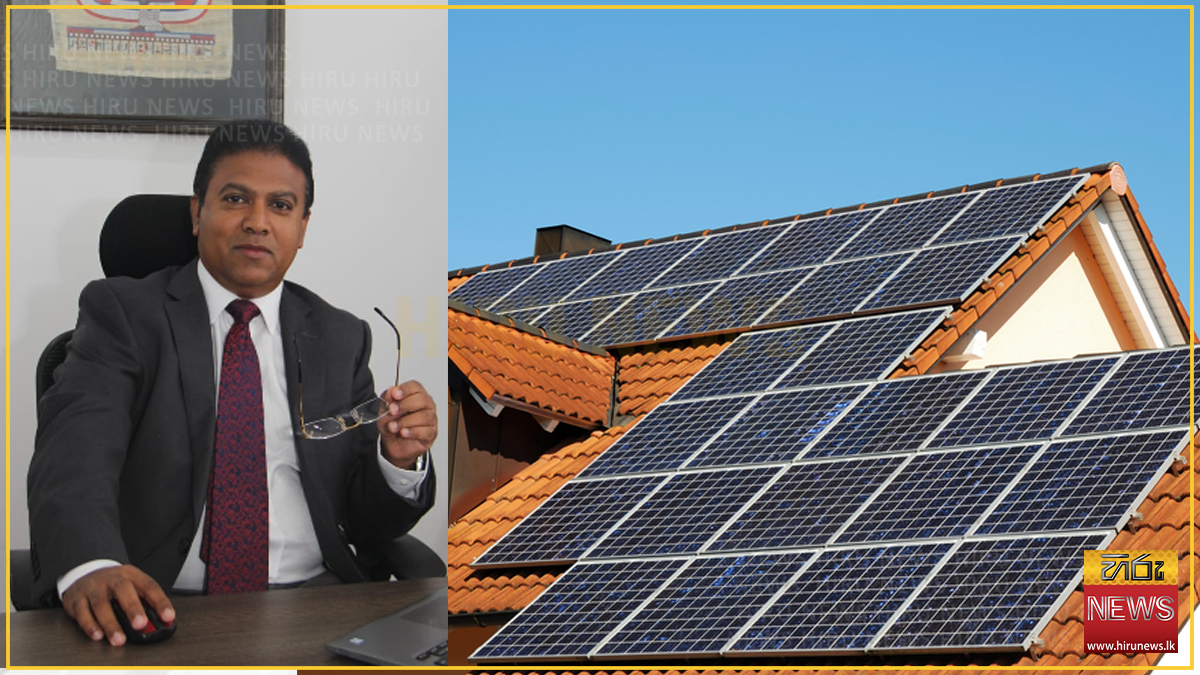
Sri Lanka must accelerate the modernisation and expansion of its electricity distribution network to accommodate growing renewable energy generation, rather than impose broad restrictions on rooftop solar, Dr. Lakmal Fernando, Deputy President of the National Chamber of Commerce of Sri Lanka, has said.
Responding to questions raised by President Anura Kumara Dissanayake at the Ceylon Chamber of Commerce's economic summit, Fernando said that while the President had discussed expanding the transmission network, the equally important challenge of strengthening the distribution system had not received sufficient attention.
He argued that rooftop solar had helped reduce electricity generation costs and dependence on imported fuel, while enabling households and businesses to invest directly in renewable energy. However, he warned that changes to established policies and inadequate investment in the distribution network could undermine investor confidence and slow the country's renewable energy transition.
Of Sri Lanka's approximately 3,000 MW of installed solar capacity, more than 2,550 MW has reportedly been developed under the feed-in tariff framework, predominantly through rooftop installations. Fernando said this capacity had helped displace more expensive electricity generation, with an estimated avoided generation cost exceeding Rs. 22 per unit.
He disputed the portrayal of rooftop solar as a burden on electricity consumers, arguing that its benefits extended beyond individual households and businesses that had installed solar panels.
According to Fernando, the programme had enabled ordinary citizens, small businesses and commercial establishments to participate in electricity generation, with investments and financial returns spread across the wider community.
He noted that feed-in tariffs applied to renewable energy projects below 10 MW, while the average project size under the framework was reportedly less than 50 kW. This, he said, demonstrated the importance of smaller investors in expanding Sri Lanka's renewable energy capacity.
Approximately 160,000 rooftop solar installations are reportedly connected to the national electricity network, representing substantial private investment by households and businesses.
Fernando called for Sri Lanka to retain a balanced approach to renewable energy procurement, combining feed-in tariffs for smaller installations with competitive tendering for larger projects.
While competitive tenders could help procure large-scale generation at competitive prices, he said such projects involved land acquisition, financing, regulatory approvals, grid connectivity and construction risks that could delay delivery.
He cited the 100 MW Siyambalanduwa solar project as an example, claiming that the tender had been awarded at approximately US$0.08 per unit, equivalent to around Rs. 28 under the exchange rate used in his comparison. By contrast, he said rooftop solar installations were generally compensated at approximately Rs. 17 per unit or less.
He also highlighted the potential foreign exchange risk associated with US dollar-linked tariffs, which could increase the rupee cost of electricity if the currency depreciated.
Fernando said the Siyambalanduwa project had reportedly yet to supply electricity to the national grid, despite being awarded approximately three years earlier. He contrasted this with rooftop solar installations that had already been completed and were generating electricity.
He argued that the effectiveness of energy policy should be measured by operational capacity delivering electricity, rather than the capacity announced or awarded through tenders.
Fernando also questioned claims that approximately 1,500 MW of solar capacity had been added over the past two years, arguing that the contribution of rooftop solar investors needed to be clearly recognised. He called for clarification of discrepancies in capacity addition figures for 2024 to 2026, including a reference to 1,040 kW in the information available to him.
He was also sceptical about projections that a further 2,600 MW of solar capacity would be developed by next year, citing the time required for financing, land acquisition, environmental clearances, grid connections and construction.
He said transparency and compliance with the applicable legal framework were essential in renewable energy procurement. Fernando disclosed that he had initiated legal proceedings concerning the allocation of approximately 650 MW of proposed projects, with the relevant matters now subject to judicial consideration.
Beyond rooftop solar, Fernando identified floating solar as an opportunity to expand generation without placing additional pressure on land resources.
He cited the proposed 5 MW Bankatuwa floating solar project and proposals for larger floating solar installations supported by battery storage in the Puttalam Lagoon area.
One concept envisages covering approximately 13% of the lagoon with solar installations, potentially offering an alternative source of electricity to conventional thermal generation at Norochcholai.
Fernando said such proposals could help reduce dependence on imported fossil fuels and strengthen energy security if they proved technically, environmentally and economically viable. He also suggested exploring floating solar installations on suitable portions of major reservoirs.
However, he acknowledged that these proposals would require detailed feasibility studies, environmental assessments and implementation planning.
Fernando identified constraints in the distribution network as a major concern, particularly as increasing solar generation creates challenges in managing voltage levels and surplus daytime electricity.
He said Sri Lanka had more than 33,000 distribution transformers and claimed that fewer than 500 might be experiencing significant technical difficulties associated with high daytime solar penetration. If confirmed, he argued, this would indicate that the problems were concentrated in a relatively small proportion of the network.
He called for a transparent, transformer-by-transformer assessment of the distribution system to establish where constraints existed, determine the capacity of individual feeders to accommodate solar power and identify the most cost-effective solutions.
Possible measures included strengthening network infrastructure, upgrading transformers, improving voltage regulation, introducing modern inverter controls and installing battery energy storage systems at locations where they would provide the greatest benefit.
Fernando argued that identifying specific constraints and addressing them would be preferable to imposing widespread restrictions on solar generation. He suggested that limited curtailment at identified problem locations could be considered where supported by technical assessments, rather than applying blanket restrictions across the sector.
He also called for battery storage incentives to be extended to households and smaller renewable energy investors.
Fernando said he had submitted proposals to allow battery storage systems to be imported duty-free, with the aim of making storage more affordable and encouraging consumers to use more of their own solar electricity while reducing pressure on the grid.
He expressed concern that incentives appeared to favour larger-scale investors, arguing that smaller installations should also be encouraged if battery storage was to play a meaningful role in stabilising the electricity network.
The cost of thermal generation and contractual capacity payments was another issue he raised. Fernando estimated that capacity payments could represent an additional cost equivalent to approximately Rs. 2 per unit of electricity consumption, with a further combined-cycle power plant potentially adding another Rs. 1 per unit.
He said these estimates required verification against relevant power purchase agreements and national electricity sales data. Nevertheless, he argued that electricity planning should consider the full cost of contractual commitments, including payments for capacity that might not be fully utilised and the foreign exchange risks associated with dollar-linked obligations.
Fernando also cited operating figures suggesting that a 300 MW generating unit had recorded a plant factor of approximately 40% last year, while another unit had reportedly operated for less than a week during the year. He said the figures warranted independent verification and highlighted the need to assess the utilisation and cost of existing thermal generation capacity.
He maintained that Sri Lanka should build on the rooftop solar sector's contribution rather than weaken the framework that had encouraged households and businesses to invest in renewable energy.
According to Fernando, the priority should be to modernise the distribution network, expand storage, improve system planning and establish transparent, technically justified operating procedures as renewable energy penetration increases.
He warned that changing established investment conditions without providing viable alternatives could discourage future investment and undermine confidence among existing solar investors.
Sri Lanka's renewable energy transition, he argued, would depend not only on expanding generation and transmission capacity but also on ensuring that the distribution network could accommodate electricity produced by thousands of decentralised installations.
The challenge, Fernando said, was to adapt the electricity system to the growth of renewable energy rather than restrict a sector that had already attracted substantial private investment.