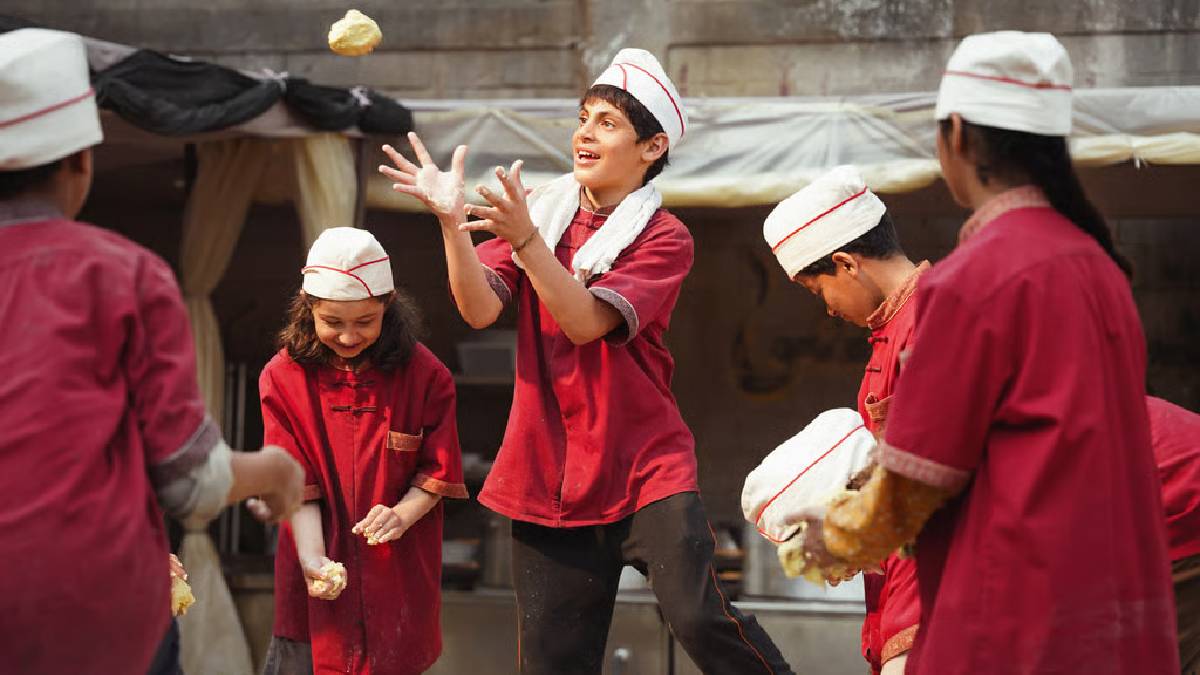
A mainland-produced film about a Chinese restaurant in Baghdad that became a wartime refuge has been selected as China’s entry for next year’s Oscars, bringing global attention to untold stories from the Iraq War.
Directed by Wen Muye and starring Shen Teng and Jiang Qiming, Once Upon a Time in the Middle East became a box-office hit after its domestic release in China in August, earning more than 2.3 billion yuan (US$344 million).
The film follows Xu Fu, a chef who travels to the Middle East to repay his debts and opens a Chinese restaurant with a local partner. When war breaks out, the eatery becomes a safe haven for children displaced by the conflict.
On October 7, the film was announced as China’s submission in the Best International Feature Film category at next year’s 99th Academy Awards.
It draws inspiration from the real-life experiences of Chinese entrepreneurs in Iraq, including Chen Xianzhong, an Arabic-language graduate of Peking University.
Chen first arrived in Iraq in 1984 as an interpreter for a Chinese company. He was among the tens of thousands of Chinese workers who went to Iraq during that period, most of whom were employed by Chinese engineering and construction firms.
After moving into business, he opened Yan Long Wan, Baghdad’s first Chinese restaurant, shortly after the Iraq War broke out in 2003.
For Chen, running a restaurant offered Chinese migrants with limited resources a way to integrate into Iraqi society. “Everyone needs to eat,” he told mainland media.
With a bar attached, the restaurant became an unlikely neutral ground amid the violence. Chen sheltered foreign journalists, local doctors, children and Chinese workers stranded by the conflict.
In 2004, he helped rescue seven kidnapped Chinese workers, providing them with food and accommodation.
Today, Chen is retired and based mainly in Beijing, but he still returns to Baghdad occasionally to support friends’ businesses and advise Chinese companies operating in Iraq.
Another entrepreneur whose wartime experiences helped shape the film was Liu Lei.
In 2003, Liu left his software job in Shenzhen and travelled to Baghdad in search of business opportunities.
He opened the Chinese Dragon Restaurant, where he served Kung Pao Chicken, fried rice and wine to US soldiers and employees of international organisations.
Liu and his partner reportedly earned more than 3 million yuan (US$450,000) in a year.
But the war soon revealed its human cost. Liu’s partner recalled a young US soldier who often spoke about wanting to return home and his frustration with the war.
Liu also sheltered a Japanese anti-war activist who worked at the restaurant and used leftover ingredients to prepare meals for war orphans.
After a suicide bombing near the restaurant killed more than 50 people, Liu and his partner closed the business and returned to China as the US military tightened security measures.
On September 30, the US formally withdrew its remaining troops from Iraq, concluding more than two decades of military involvement in the country.
Rather than focusing on military operations, Once Upon a Time in the Middle East portrays the war through the experiences of civilians navigating daily life amid the conflict.
In a public speech, director Wen said that Chinese cuisine, with its emphasis on gathering and sharing, has a natural connection to peace.
Through the image of a dining table, he hopes the film will remind audiences that “If people can sit down and share a meal, they should not go to war. War destroys lives and leaves no true winners.”
One online commenter wrote: “This film is a winner in my heart, even without an award. If leaders could share a meal and think about the next generation, the world would be a better place.”
-South China Morning Post