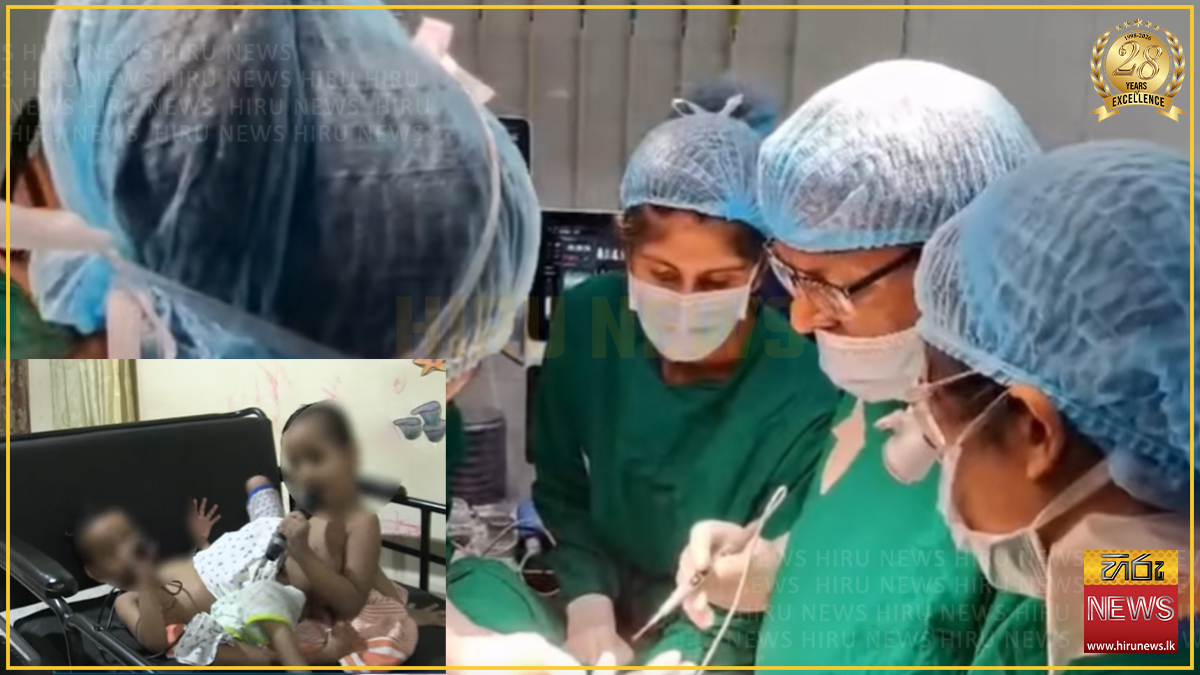
A team of doctors from the Peradeniya Teaching Hospital, the Sirimavo Bandaranaike Children's Hospital, and the Faculty of Medicine at the University of Peradeniya successfully separated conjoined twins who were fused at the pelvis.
This marks the first time in the world that such a surgery took place, where one of the two kidneys belonging to only one child was removed and successfully transplanted into the other child, according to Mathula Hettiarachchi, Consultant Surgeon at the Peradeniya Sirimavo Bandaranaike Specialized Children's Hospital and Senior Lecturer at the Faculty of Medicine, University of Peradeniya.
A team led by Consultant Obstetrician and Gynaecologist Chaminda Kandauda delivered these conjoined twins via caesarean section in 2021 at the Peradeniya Teaching Hospital to a mother residing in Mawanella, and the children underwent the kidney transplant surgery in 2024.
The separation surgery took place on the 10th of this month, after their kidney functions returned to normal.
The two children received treatment in the intensive care unit since that day and can be transferred to a normal ward within the next few days, Mathula Hettiarachchi stated.
He further expressed that only one surgery to separate conjoined twins occurred in Sri Lanka so far, and a separation surgery involving the removal of a kidney from one child to transplant it into the other child never took place in any country in the world until now.
He added that the weight of the two children being at an adequate level was important to perform such a serious surgery under anaesthesia, which is why the separation surgery did not take place for five years after birth.
Bandula Samarasinghe, Professor at the Department of Surgery, University of Peradeniya and Consultant Surgeon at the Peradeniya Teaching Hospital, said that around 200 paediatric kidney transplants took place at the Peradeniya Teaching Hospital so far, and that experience proved highly useful in performing this surgery successfully.
Ashani Ratnayake, Consultant Anaesthetist at the Peradeniya Teaching Hospital and Senior Lecturer at the Faculty of Medicine, University of Peradeniya, noted that the children were kept under anaesthesia for a long period from 7:00 a.m. to 9:00 p.m. to perform the surgery, and the proper functioning of their hearts, lungs, circulatory systems, and brains supported the success of the operation.
She stated that anaesthetizing and reviving even a child in good health remains a challenge, and despite such conditions, keeping these two children under anaesthesia for about 14 hours, successfully performing the surgery, and reviving them resulted from the doctors, nursing staff, and all other personnel working together as a team.
Akalanka Jayasinghe, Consultant Orthopaedic Surgeon at the Sirimavo Bandaranaike Specialized Children's Hospital, said that an abnormal positioning appeared in the pelvic girdle where these two children connected, and their legs were positioned transversely.
He added that because the legs were positioned at 90 degrees relative to the head, separating the children without causing damage to the nerves and blood circulation going to the legs posed a challenge.
A team of about 30 people, including 15 consultant doctors, participated in this surgery.
The children currently remain in good health, and they have a few more surgeries to undergo in the future, Mathula Hettiarachchi stated.
Professor Saman Nanayakkara, Consultant Anaesthetist and Dean of the Faculty of Medicine at the University of Peradeniya, Senaka Navanaliya, Deputy Director of the Peradeniya Teaching Hospital, and Kavisha Dissanayake, Consultant Anaesthetist, also expressed their views.