



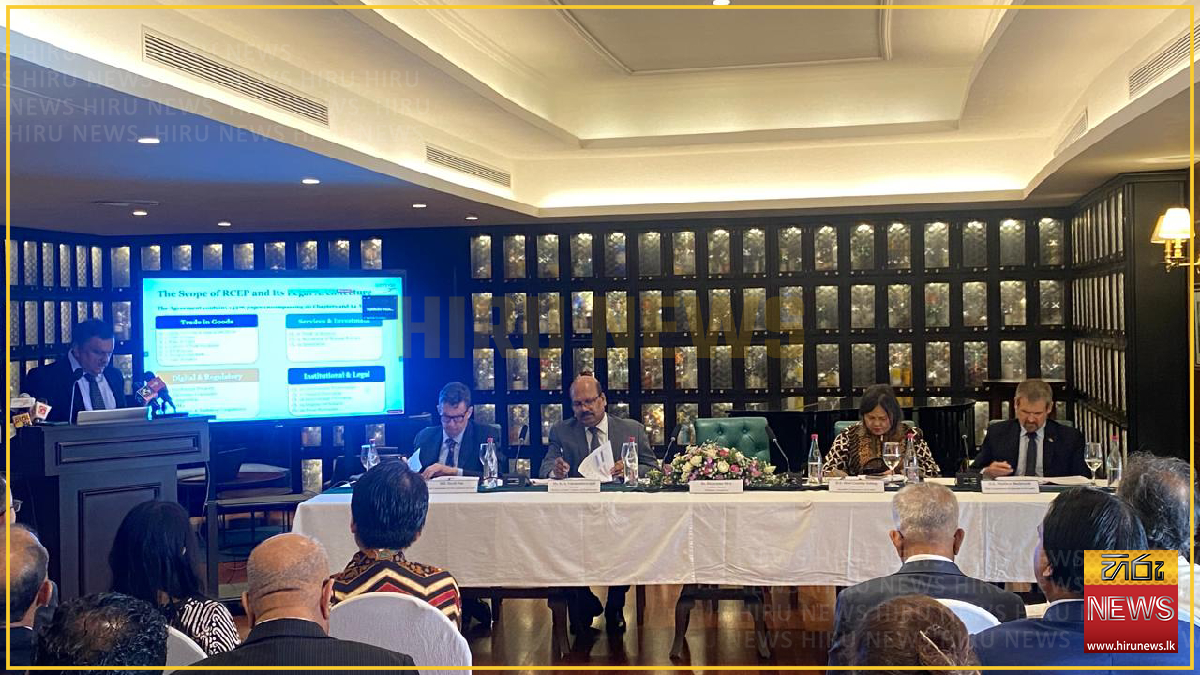


Sri Lanka will require strong commitment from both the government and the private sector as it moves closer to a potential application to join the Regional Comprehensive Economic Partnership (RCEP), diplomats and experts have said.
They also noted that member states will closely assess macroeconomic stability, policy credibility, and a country’s ability to implement reforms before approving new entrants to the free trade bloc.
The views were expressed at a roundtable discussion in Colombo on “Sri Lanka, RCEP and the Emerging Global Trading Order”, organised by the Pathfinder Foundation.
Former Sri Lankan Ambassador to the World Trade Organisation, Dr Dayaratna Silva, said joining RCEP could significantly reshape Sri Lanka’s trade outlook.
“Sri Lanka is heavily dependent on a limited number of export markets. Integrating into RCEP could help diversify our trade partnerships towards the dynamic Asia-Pacific region, reducing dependence on any single market,” he said.
“It would also provide greater market access to one of the world’s largest economic groupings, representing around one-third of global GDP.”
He added that RCEP membership could help Sri Lanka integrate into regional production networks.
“Modern trade operates through regional value chains rather than isolated national industries. Membership would allow Sri Lanka to integrate into ASEAN manufacturing and value chains, deepen engagement, and align with Asia’s economic trajectory,” he said.
However, Dr Silva cautioned that accession would require deeper trade liberalisation.
“RCEP represents a regime with a deeper level of liberalisation than what currently exists in Sri Lanka. Tariff reductions and eliminations are typically phased over 20 years. If we cannot commit to that, then trade reform becomes impossible,” he said.
Australian High Commissioner to Sri Lanka, Mathew Duckworth, stressed the importance of domestic consultation in shaping negotiations.
“Preparation requires commitment from government, but importantly from business as well,” he said.
“In Australia, we consult industry extensively to understand concerns and priorities. That helps secure buy-in and guides our negotiating positions. A similar process will be important for Sri Lanka.”
New Zealand High Commissioner David Pine said RCEP accession would not introduce unfamiliar reform demands, but would formalise ongoing economic adjustments.
“RCEP members will look closely at macroeconomic stability and policy credibility,” he said.
“Sri Lanka already has a strong narrative in this area, reflected in its IMF programme. But debt sustainability, exchange rate stability, and political stability are all scrutinised during accession.”
He added that Sri Lanka should view RCEP as an opportunity rather than a burden.
“Meeting RCEP standards is not an externally imposed challenge. It reflects reforms already underway,” he said.
“The real opportunity lies in using RCEP to support Sri Lanka’s vision of sustained growth and deeper integration into the Indo-Pacific economy.”
He warned that limiting engagement to minimum requirements would undercut long-term benefits.
“There is nothing automatic about success. But if Sri Lanka looks ahead to a prosperous, connected economy by 2040, RCEP would likely be one of the most significant steps in that journey,” he said.
Meanwhile, Secretary to the Ministry of Trade and Commerce K. A. Vimalenthirajah said Sri Lanka’s Free Trade Agreement with Thailand, signed in 2024, is expected to move towards implementation soon.
“There were legal challenges filed under FR procedures, but those have now been resolved. In the near future, the agreement will be submitted to Cabinet for operationalisation,” he said.
Sri Lanka submitted its Letter of Intent to join RCEP on 28 June 2023.
A preliminary questionnaire was issued in October 2025 to assess readiness and compliance with the agreement’s requirements, with responses required by January 2026.
The ministry said Sri Lanka submitted its answers earlier this year.
RCEP is currently the world’s largest free trade agreement, bringing together 15 countries representing around 30% of global GDP and one-third of the world’s population.
The agreement came into force in 2022 following phased ratifications across member states.
It covers trade in goods and services, investment, intellectual property, e-commerce, and SME development, and is widely seen as a key pillar of Asia’s emerging trade architecture.
Latest News
GTA 6 gameplay videos, full map leaked

Taxi passengers urged to take safety precautions

Ebola cases in Congo exceed 5,000, government data shows
Oil extends climb on prolonged Hormuz export uncertainty

Sampath Bank partners with GV Auto on EV financing
Hemas makes first overseas acquisition with $16.2m Kenya deal

India’s buffalo meat exports cross 5 billion dollars as global demand climbs

Wife of former Cabinet Minister dies following tragic incident

Three Port City firms set for strategic enterprise status

Charles Spencer to tell Diana’s story in new book