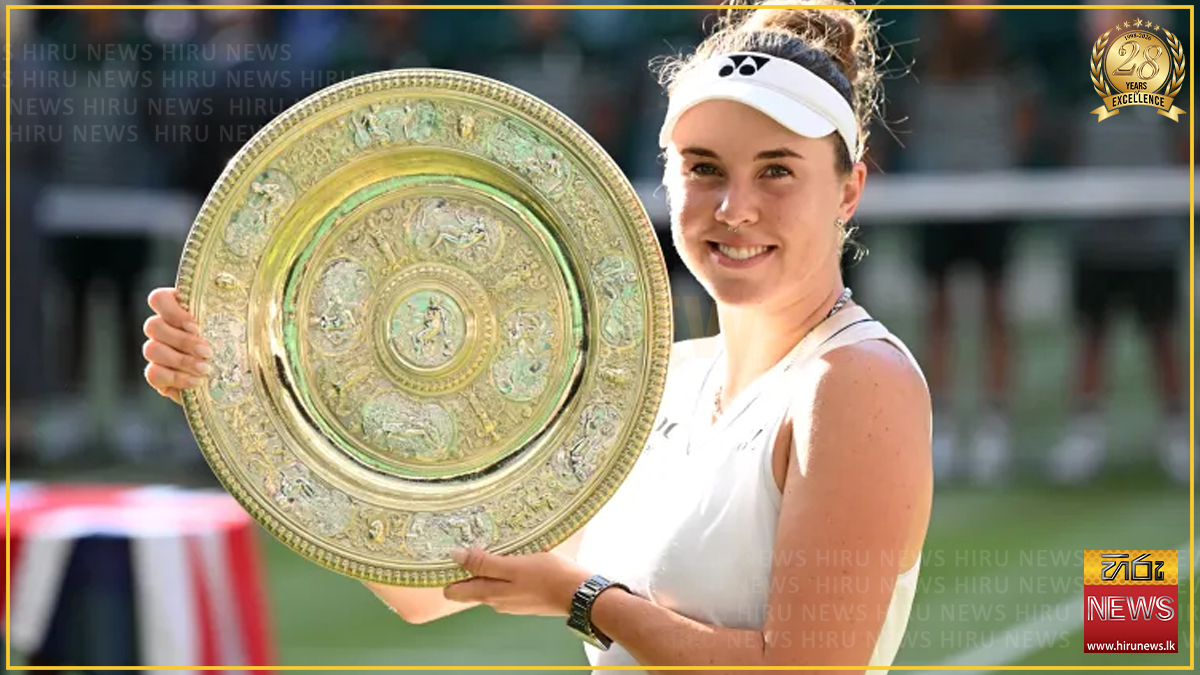
Linda Noskova battles back against Karolina Muchova to win Wimbledon title
Linda Noskova put a dramatic second-set collapse behind her to win her first grand slam title in a wild Wimbledon final.The winner of the all-Czech clash between Noskova and Karolina Muchova was guaranteed to be the third woman from the central European country to lift the Venus Rosewater Dish in the last four years.But it was another former Czech champion, the late Jana Novotna, that came to mind when Noskova blew a 5-2 lead in the second set and five match points to send the contest to a decider.Novotna’s tears on the shoulder of the Duchess of Kent after she squandered an apparently decisive advantage against Steffi Graf in the 1993 final remains one of Wimbledon’s most famous moments.Novotna had to wait until 1998 for her cathartic winning moment but 21-year-old Noskova, playing in her first grand slam final, impressively put the disappointment behind her to claim a 6-2 5-7 6-3 victory.She is the youngest women’s champion since another Czech, Petra Kvitova, who was watching from the Royal Box, in 2011 and follows in the footsteps of 2023 champion Marketa Vondrousova and 2024 winner Barbora Krejcikova.“It feels incredible,” said Noskova after being presented with the trophy by the Princess of Wales.“All these matches have been so tough. Today especially, it’s never easy to get the last point. Karo, you really made me work for it. We’re friends. I’m so glad that I could play my first grand slam final with you. I think we made history today.”Noskova was unable to hold back the tears as she paid tribute to her mother Ivana, who died from cancer two years ago.“There’s also one more person I would like to thank, which is my mum. I definitely would not be standing here without her so thank you,” said Noskova, blowing a kiss to the sky.Muchova struggled to begin her interview through her own tears but praised her young compatriot, saying: “It’s really tough to find any words.“I’ll start with Linda, my ex-friend. I’m kidding, obviously – kind of. You’re so young and this was your first final of a grand slam and the way you handled it and the way you played, it was unbelievable.”For just over an hour, this appeared to be one of Wimbledon’s most straightforward finals, with Noskova handling her maiden major showpiece with aplomb and dominating her more experienced compatriot, who lost to Iga Swiatek in the French Open final in 2023.Leading 6-2 5-2, Noskova was on the brink, and Muchova had to scramble with everything she had to force the ninth seed to try to serve it out, saving three match points as the crowd willed a contest to break out.Little did they know what was about to unfold. Noskova moved 30-0 ahead in the next game and to within two points of victory, then a fourth chance arrived and she double-faulted.Muchova created an astonishing seven break points, three of which Noskova saved with aces, before finally her resistance ran out.Still Noskova had the scoreboard pressure and a fifth match point arrived in Muchova’s next service game but once again the 10th seed had the answers and incredibly she made it five games in a row to level the contest.Noskova headed back to her chair with her head in her hands before leaving the court for the most important bathroom break of her career.Kvitova was one of seven former champions in the Royal Box along with the likes of Maria Sharapova, Billie Jean King and Martina Navratilova, and all would have empathised with the position Noskova found herself in.But the 21-year-old had showed impressive poise all through her run, saving a match point of her own in the third round against Sorana Cirstea, and she knew how important the start of the deciding set was.Had Muchova taken any of three break points in the opening game, the outcome might have been different, but Noskova fought off the challenge to break the sequence of games against her and began to find her flowing shots again.Muchova wowed the crowd with a between-the-legs shot in the fifth game but Noskova had the last laugh as she moved, once again, into a 5-2 lead.Noskova is not your average 21-year-old tennis player. A passionate environmentalist, she spent part of her off-season last year volunteering at a school in Tanzania, keeping her profession a secret.Maybe such worldly perspective helped, for this time she did not blink, sending down an ace to bring up a sixth match point and this time taking it thanks to another unreturnable serve before collapsing to the court in triumph – and relief.From news to politics, travel to sport, culture to climate – The Independent has a host of free newsletters to suit your interests. To find the stories you want to read, and more, in your inbox, click here. - MSN