



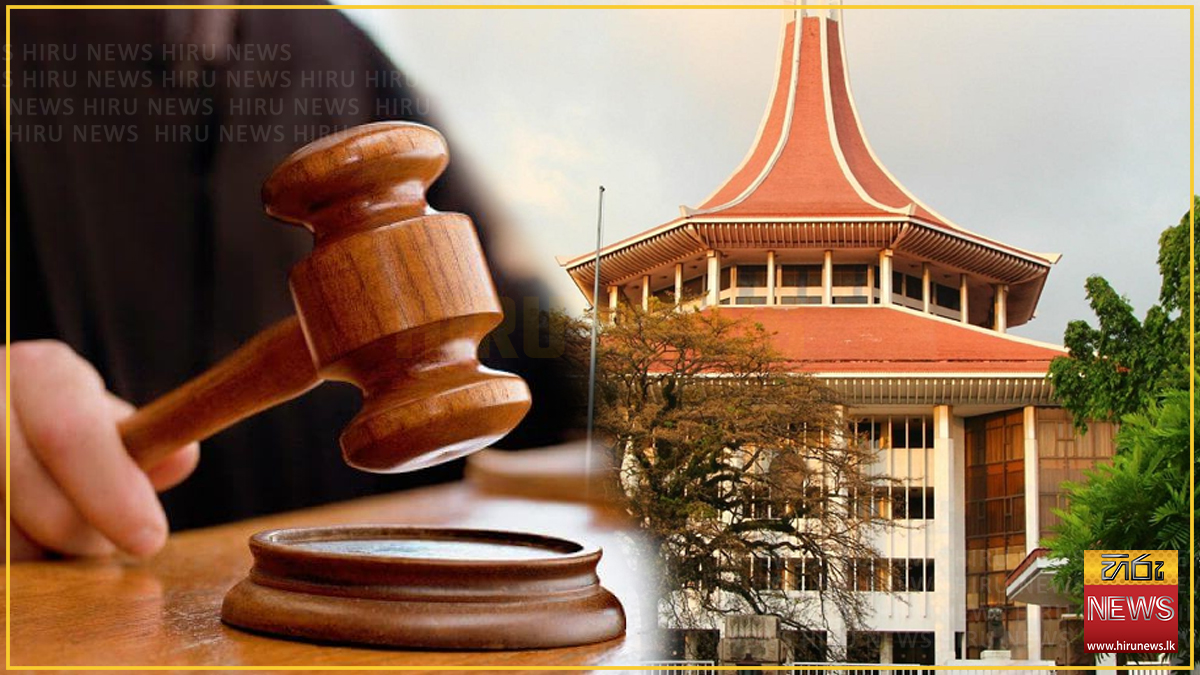


The Supreme Court today (1) began hearing petitions filed against the 22nd Amendment Bill presented to Parliament by the government.
The petitions were taken up before a five-judge bench comprising Chief Justice Preethi Padman Surasena, Achala Vengappuli, Arjuna Obeyesekere, Sampath Abeykoon, and Gihan Kulatunga.
Making initial submissions on behalf of the petitioner, the Bar Association of Sri Lanka, President's Counsel M.A. Sumanthiran stated before the court:
"My Lord, this is a bill that directly impacts the independence of the judiciary. Through this, the term of the Chief Justice is extended by two years, and the retirement age of other judges is also extended. Therefore, a conflict of interests arises at this juncture. Taking this situation into consideration, I request that these petitions be heard before a full bench comprising all the judges of the Supreme Court."
Subsequently, making submissions on behalf of another petitioner party, President's Counsel Saliya Peiris stated before the court:
"My Lord, the proposed bill extends the retirement age of judges. Justice must not only be done, but it must also be seen to be done. According to the Bangalore Principles, judicial processes must be independent. Therefore, I also request that this bill be heard before a full bench."
President's Counsel Saliya Peiris, Ali Sabry, Jeffry Alagaratnam, Eraj Silva, Sreenath Perera, Anura Meddegoda, and Maithri Gunaratne, appearing for other groups of petitioners, made further submissions regarding this request.
Appearing for the Attorney General, Solicitor General Viraj Dayaratne stated before the court:
"My Lords, in terms of Article 132(3) of the Constitution, the discretion to appoint a Supreme Court bench is vested in the Chief Justice. Pursuant to that provision, the Chief Justice may nominate a number of judges exceeding two as a Supreme Court bench. The complete power to determine the composition of the bench is vested in the Chief Justice. External parties have no ability to interfere in it."
During these proceedings, President's Counsel Nigel Hatch and other lawyers, appearing for an intervening petitioner, pointed out to the court that the discretion to decide the composition of a bench lies with the Chief Justice.
Following this, having considered all the submissions presented, the five-judge bench headed by the Chief Justice delivered its order stating that the request made by the petitioner parties to have the relevant petitions heard before a full bench is refused.
Accordingly, the bench ordered that the petition inquiry be proceeded with before the existing bench.
The petition hearing then commenced.
Presenting arguments on behalf of the Bar Association of Sri Lanka, which had filed a petition, President's Counsel M.A. Sumanthiran stated before the court:
"Several articles contained in the Constitution are violated through the proposed amendment. Particularly, Article 3 is violated. In such an instance, the Cabinet should decide to submit this bill for a referendum. Such amendments that violate the provisions mentioned in the Constitution must certainly be subjected to a referendum. Articles 3 and 4 of the Constitution are directly connected to popular sovereignty. All changes made to Article 4 affect Article 3.
Current Minister Vijitha Herath, while in the opposition, presented a private member's motion to abolish the executive presidency. However, the court stated that a referendum was required for it. In its ruling on the 2022 Inland Revenue Bill, the court declared that a referendum was necessary to extend the retirement age of judges. A superior court ruling has stated that judicial independence is contained within Article 3 of the Constitution.
Article 107 of the Constitution refers to the judiciary, outlining the retirement age of superior court judges. The proposed amendment directly impacts the foundational base of the Constitution. Therefore, this amendment cannot be approved even through a referendum. The Bar Association wrote to the authorities regarding the gravity of this, but received no response. Ultimately, the Bar Association was compelled to summon a general meeting to discuss this matter.
Since the current government assumed power, six judges have retired, alongside two Chief Justices. If this amendment is passed, the independence of the judiciary will be violated."
Making submissions for Professor G.L. Peiris, who had also filed a petition, President's Counsel Ali Sabry stated:
"The Constitution specifies the retirement age of a Supreme Court judge as 65 and an Appeal Court judge as 63. The proposed bill limits the term of the Chief Justice. A direct clash with popular sovereignty occurs through that. Judges must have an environment to discharge their duties freely. Just because there is a two-thirds majority in Parliament, that freedom cannot be disrupted. This bill directly impacts judicial independence, thereby violating popular sovereignty. I regret having to make such submissions before this court. We are compelled to make such submissions to protect the independence of the judiciary and to safeguard your lordship's dignity.
The executive should not inconvenience you in this manner. Not only lowering, but even raising the retirement age of judges violates judicial independence. Sri Lanka is one of the oldest democracies in Asia. We do not want to become a China or a Vietnam."
Subsequently, retired Air Force officer Shantha Jayathilaka, who filed a petition, made submissions before the court demonstrating how the proposed amendment violates judicial independence and popular sovereignty.
Accordingly, he noted that the relevant bill cannot be passed without a referendum.
Presenting arguments on behalf of another petitioner party, President's Counsel Thisath Wijegunewardena stated:
"This bill proposes to extend the retirement age limit of superior court judges by two years. Empowering only Parliament to pass the bill is extremely dangerous. It violates the independence of the judiciary. Therefore, this must be submitted for public approval. If it is approved solely within Parliament without a referendum, it directly violates the independence of the judiciary."
Following that, President's Counsel Sreenath Perera, appearing for a group of petitioners, stated:
"The provisions contained in the proposed bill directly or indirectly affect the judges of this court. There is a very important principle of law: it is inappropriate for a judge to adjudicate on a matter that affects them. Since this bill affects the judges of this court, it is not appropriate for your lordships to hear these petitions. Then what is the next alternative? That is a referendum. Taking a decision regarding this bill must be placed before the public."
The petition inquiry is continuing.
Latest News
Man shot by ICE agents in detention with bullet in back

Trump approval falls to record low of 32% as high costs bite

Denmark says NATO shares responsibility for Arctic security under Greenland deal

Infantino says he is open to talks over Fifa reform

UK to provide Saudi Arabia with 'defensive' military support, says Burnham

Paramount settles antitrust case with state AGs

US to open two new military bases in Greenland, sources say

Iranian foreign minister arrives in New York for UNGA

Calvin Harris recognised for 1.6m world record DJ set crowd

White House launches 24-hour ‘Trump TV’ channel