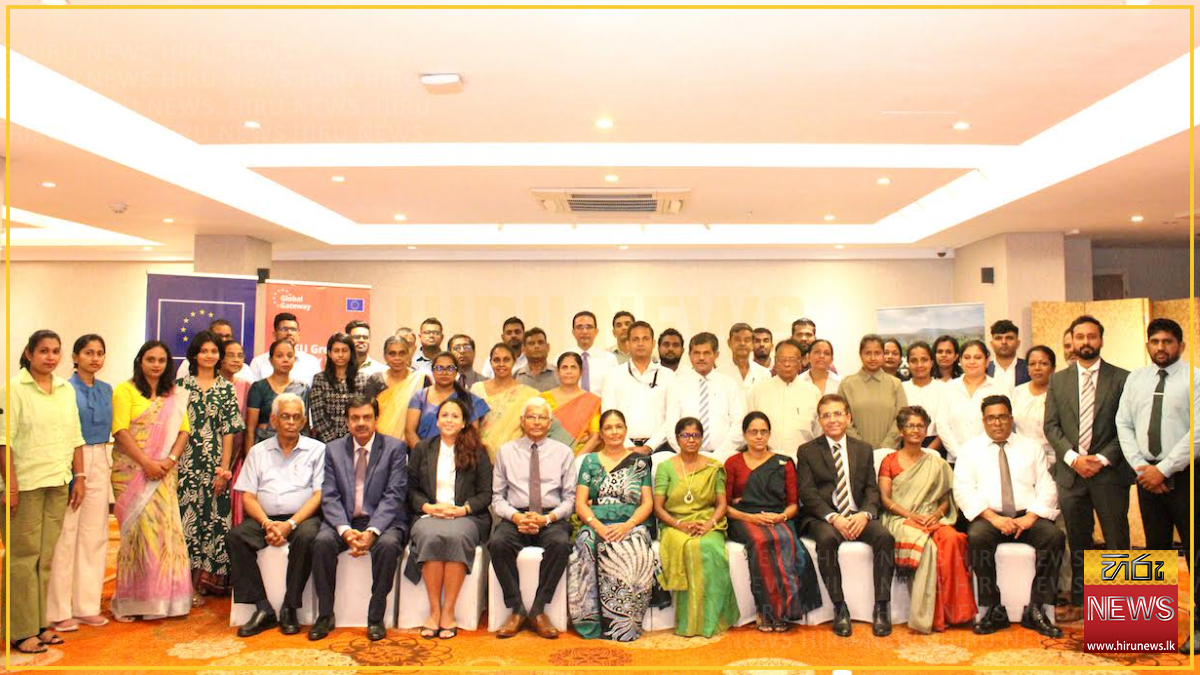


Building momentum for a more sustainable marketplace, more than 50 public and private sector leaders came together in Colombo to advance Sri Lanka’s National Eco-Labelling Framework (NELF).
The diverse group of representatives from government institutions, industry associations, eco-labelling scheme owners, certification bodies, technical experts and development partners explored ways to strengthen a trusted system for sustainable products, responsible businesses and informed consumer choices.
The stakeholder consultation on “National Eco-Label Sri Lanka: Framework Strengthening and Harmonisation” was organised through the European Union-funded Green Recovery Facility, implemented by Expertise France in collaboration with the Ministry of Environment (MoE).
The initiative supports Sri Lanka’s transition towards a greener and more sustainable economy by strengthening policies, technical standards and market mechanisms that encourage sustainable production and consumption.
Highlighting the importance of these efforts for Sri Lanka’s competitiveness in global markets, Dr Johann Hesse, Head of Cooperation at the Delegation of the European Union to Sri Lanka and the Maldives, said, "As sustainability becomes an increasingly important factor in global trade, credible and transparent environmental standards are essential.”
“Through the Green Recovery Facility, the European Union is supporting Sri Lanka in building the institutions and technical capacity needed to strengthen sustainable production, increase consumer confidence and unlock new market opportunities for Sri Lankan businesses."
Eco-labelling is becoming an increasingly important tool worldwide as consumers, businesses and governments seek more reliable ways to identify environmentally responsible products.
Today, nearly 1.8 million products globally carry recognised eco-labels. However, with more than 300 eco-labels estimated to exist in the United States alone, and 6 in 10 European consumers finding it difficult to distinguish credible environmental claims from misleading ones, the need for trusted and transparent certification systems has become more important than ever.
Sri Lanka launched its National Eco-Labelling Framework in 2022 as a foundation for developing a nationally recognised eco-labelling system. Several sector-specific initiatives are already operating, including the Green Label introduced by the Green Building Council of Sri Lanka and energy rating initiatives led by the Sri Lanka Sustainable Energy Authority.
The ongoing EU-funded Green Recovery Facility initiative focuses on assessing existing eco-labelling schemes, aligning technical criteria, strengthening governance arrangements and developing a practical roadmap for implementation.
The programme also includes targeted capacity-building activities to support existing and emerging eco-labelling scheme owners in strengthening existing good practices and improving scheme robustness to reduce the risk of greenwashing.
H.M.P. Abeykoon, Additional Secretary, Ministry of Environment, reaffirmed the Government of Sri Lanka’s commitment to developing a credible, scalable and aligned with internationally recognised standards.
“A nationally recognised eco-labelling system will strengthen consumer confidence, support sustainable industries and help Sri Lankan businesses respond to evolving environmental expectations in domestic and international markets,” she said.
Latest News
Iran President Pezeshkian to visit India for BRICS summit

Inflation projected to stay higher until early next year
Apple may delay the iPhone 18 until 2027 as premium models get fall launch

Taylor Swift to become Nashville Songwriters Hall of Fame's youngest inductee

Brazil recovers Matisse paintings stolen from Sao Paulo library

Hormuz traffic slows further after US threatens more economic pressure on Iran
First Sri Lanka-India Test begins today in Galle
Iran defiant on strait as Trump tells Americans to accept high gas prices

6 dead, including suspect, in series of killings in Michigan
Hatton-Colombo main road reopened for traffic