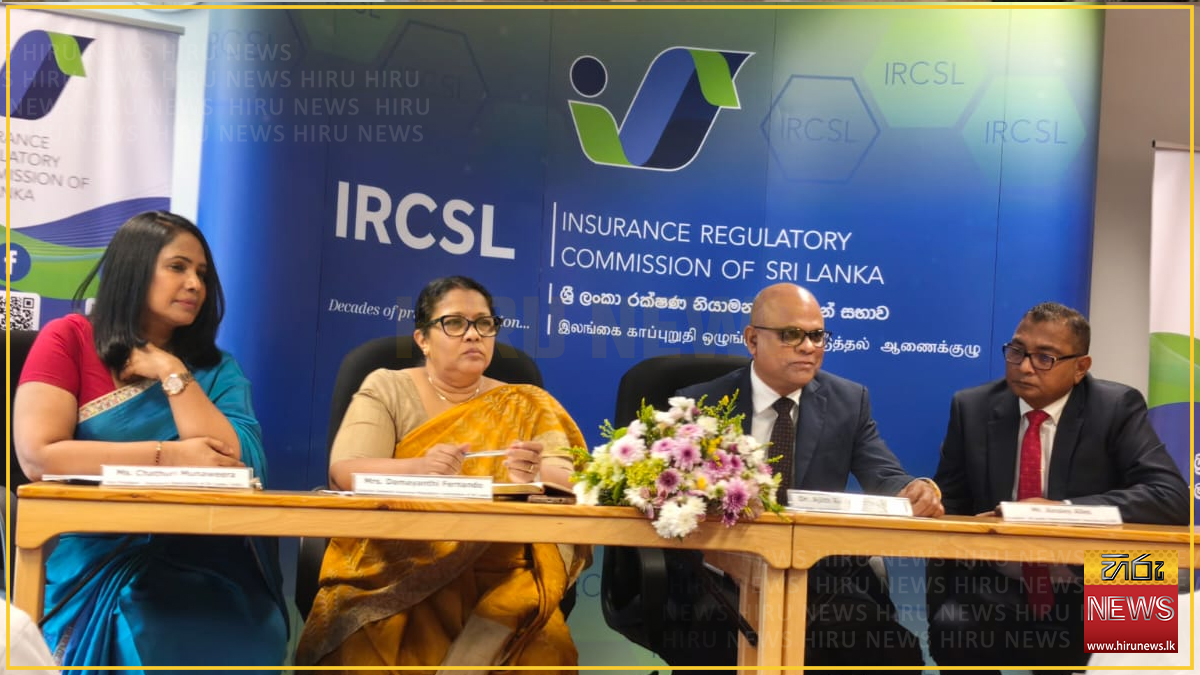
Insurance Regulatory Commission of Sri Lanka (IRCSL) marked 25 years of transforming Sri Lanka’s insurance industry at a special media briefing yesterday, where officials also revealed that insurance claims relating to Cyclone Ditwah have exceeded Rs. 57 billion.
IRCSL Chairman Ajith Raveendra De Mel said local insurance companies have received claims amounting to over Rs. 57 billion following the cyclone, with a portion of these already settled.
He noted that this represents the largest insurance claim event in the country’s history, surpassing even claims recorded after the 2004 Indian Ocean tsunami, which involved more fatalities than property damage.
According to De Mel, the higher claim value following Cyclone Ditwah was mainly due to increased property damage and a gradual rise in the number of people taking insurance cover.
During the event, IRCSL officials highlighted key milestones achieved over the past two and a half decades, noting how the Commission has evolved from a basic supervisory body into a modern, data driven regulator.
IRCSL Director General Damayanthi Fernando said the regulator has successfully transitioned from a rule based supervisory framework to a robust risk based system.
“Through pivotal initiatives such as implementing Risk Based Capital models and driving digital transformation, the Commission has balanced its dual role as a strict protector of policyholders and a facilitator of industry growth, ensuring the sector remains a resilient cornerstone of the economy,” she said.
De Mel also stressed the importance of ongoing professional development, knowledge sharing and strategic reforms to maintain high professional standards within the regulatory body.
He added that several new initiatives are being planned to strengthen the insurance sector, enhance policyholder protection and improve insurance penetration, which remains lower than in countries such as India.
Among these initiatives is the planned launch of an Insurance Roadmap aimed at doubling insurance penetration by 2030 and tripling it by 2035.
De Mel also noted that Sri Lanka is currently the only country where a motor insurance cover can be used to make claims even if the full premium has not been paid. He said the proposed launch of a Digital Motor Insurance Card will help address this issue.
In addition, the regulator plans to introduce a standard mortality table reflecting the experience of insured lives in Sri Lanka, which will support improved actuarial valuation, product pricing and risk management within the life insurance sector.
Sri Lanka’s insurance industry currently comprises 29 insurance companies, including 14 general insurers and 15 long term insurers, along with 82 insurance brokering companies and 29 loss adjusters.