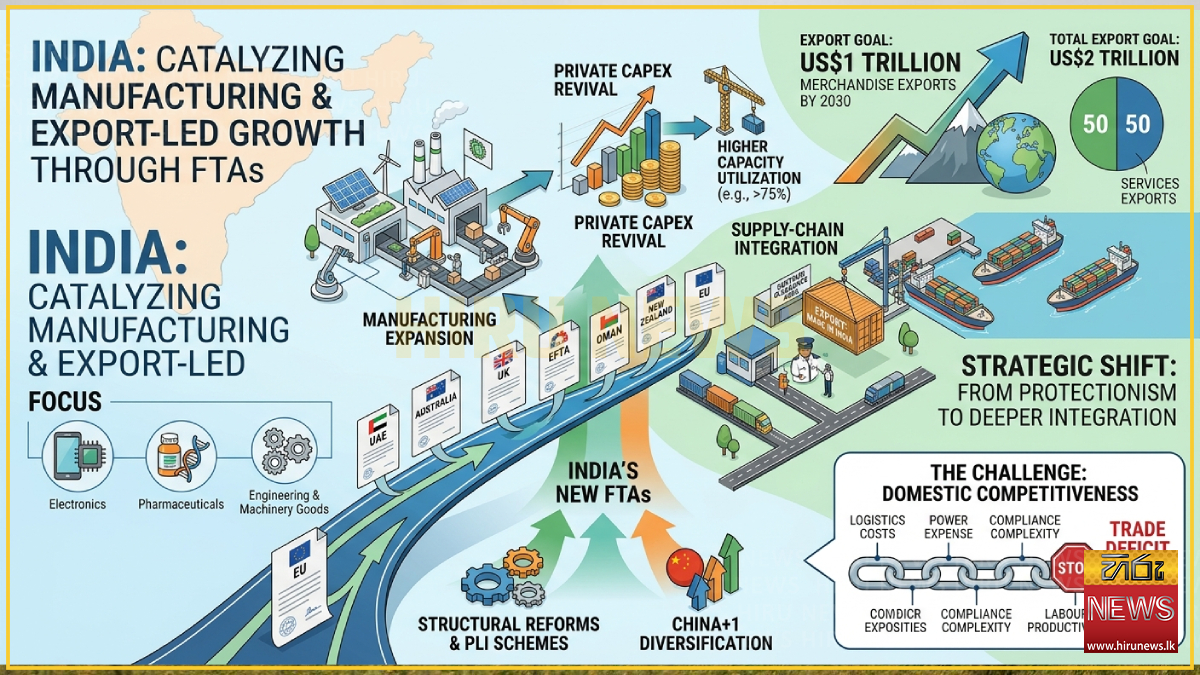
India's new generation of Free Trade Agreements can act as a catalyst for manufacturing expansion, private capex revival and supply-chain integration, with Electronics, Pharmaceuticals and Engineering & Machinery Goods positioned as the strongest beneficiaries.
Yes Securities said the agreements, combined with PLI schemes and "China+1" diversification, give India its clearest shot yet at achieving US$1 trillion in merchandise exports by 2030.
"India's recent wave of FTAs marks a fundamental shift in economic strategy from cautious protectionism toward deeper global trade integration," Yes Securities said in its report.
"These FTAs are not merely trade agreements but represent the foundation of a multi-year industrial and export-led growth cycle," Yes Securities noted.
Agreements with the UAE, Australia, UK, EFTA, Oman, New Zealand and the EU are being implemented alongside industrial corridors, port upgrades and supply-chain localisation. That mix, the brokerage said, makes India one of the few economies with the scale, labour force and domestic market size to absorb large manufacturing relocation.
The biggest transmission mechanism may be investment. "One of the strongest arguments in favour of FTAs is their potential ability to revive India's stagnant private investment cycle," Yes Securities said. With capacity utilisation around 75%, companies lack confidence in large capex. Exports through FTAs can provide sustained demand, improve utilisation and economies of scale, and eventually trigger stronger private-sector investment, mirroring the East Asian path where exports catalysed manufacturing expansion and capital formation.
Services are expected to remain a parallel engine. India is targeting US$2 trillion in total exports by 2030, split evenly between merchandise and services. Yes Securities said UK and EU agreements improve access for IT services, consulting, engineering R&D and financial services, reinforcing India's edge in skilled labour and technology.
But the brokerage cautioned that market access alone is not enough. "The strongest counterargument is that India's primary challenge lies not in market access but in domestic competitiveness," it said.
Merchandise exports grew at just 3.5% CAGR over 2015-2025. Structural bottlenecks like high logistics costs, expensive power, compliance complexity and lower labour productivity remain. Without fixing these, FTAs could widen trade deficits if imports rise faster than exports.
- The Economic Times
Yes Securities said the agreements, combined with PLI schemes and "China+1" diversification, give India its clearest shot yet at achieving US$1 trillion in merchandise exports by 2030.
"India's recent wave of FTAs marks a fundamental shift in economic strategy from cautious protectionism toward deeper global trade integration," Yes Securities said in its report.
"These FTAs are not merely trade agreements but represent the foundation of a multi-year industrial and export-led growth cycle," Yes Securities noted.
Agreements with the UAE, Australia, UK, EFTA, Oman, New Zealand and the EU are being implemented alongside industrial corridors, port upgrades and supply-chain localisation. That mix, the brokerage said, makes India one of the few economies with the scale, labour force and domestic market size to absorb large manufacturing relocation.
The biggest transmission mechanism may be investment. "One of the strongest arguments in favour of FTAs is their potential ability to revive India's stagnant private investment cycle," Yes Securities said. With capacity utilisation around 75%, companies lack confidence in large capex. Exports through FTAs can provide sustained demand, improve utilisation and economies of scale, and eventually trigger stronger private-sector investment, mirroring the East Asian path where exports catalysed manufacturing expansion and capital formation.
Services are expected to remain a parallel engine. India is targeting US$2 trillion in total exports by 2030, split evenly between merchandise and services. Yes Securities said UK and EU agreements improve access for IT services, consulting, engineering R&D and financial services, reinforcing India's edge in skilled labour and technology.
But the brokerage cautioned that market access alone is not enough. "The strongest counterargument is that India's primary challenge lies not in market access but in domestic competitiveness," it said.
Merchandise exports grew at just 3.5% CAGR over 2015-2025. Structural bottlenecks like high logistics costs, expensive power, compliance complexity and lower labour productivity remain. Without fixing these, FTAs could widen trade deficits if imports rise faster than exports.
- The Economic Times