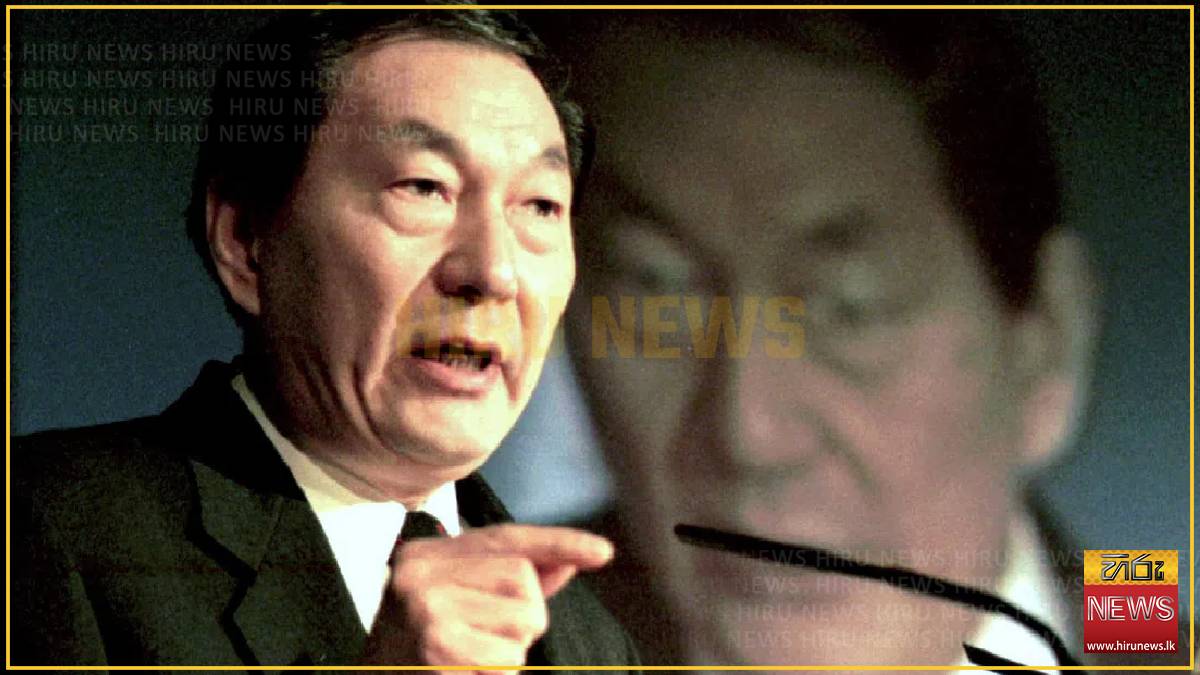
China’s former premier Zhu Rongji, whose bold economic reforms propelled his country to become the world’s second-largest economy, has died at age 98.
He died in Beijing on August 12, state news agency Xinhua reported.
As Vice-Premier from 1993 and then Premier from 1998 to 2003, Mr Zhu was primarily responsible for economic reforms during some of the pivotal years in China’s transformation from a planned economy to a socialist market, a feat that would not have been possible if not for the courage of his convictions.
At a time when reform and opening up, which started in 1978, appeared to have stalled particularly after the Tiananmen crackdown in 1989, he drove it forward through measures such as restructuring of the country’s state-owned enterprises and tax system and by getting China to join the World Trade Organisation.
While his policies were largely successful, they also caused hardship to some segments of society and had unintended adverse consequences later on, making his legacy a mixed one.
Mr Zhu, known as a straight-talker who got things done, cannot be faulted for timidity: he unflinchingly took tough and far-reaching measures that he believed were needed for China’s progress even when he knew they would be unpopular.
As he said at a press conference when he became China’s fifth premier in 1998: “Whether it is a minefield or an abyss that lies ahead, I will go forth without hesitation and serve with all my energy until my dying breath.”
Indeed, compared with the premiers who came before and after him, Mr Zhu was widely recognised by both his supporters and critics as having left the most profound imprint on China’s economy.
Zhu was instrumental in China’s accession to the World Trade Organisation in 2001. This transformative move boosted exports and inward foreign investment, turning the country into the world’s factory.
The move set China on a course to overtake Japan’s economy as the world’s second-largest after the United States, which it did in 2010, and for millions of Chinese to be elevated into the middle class.
But not all appreciated the move. People haunted by the humiliating memory of British and other foreign powers forcing Qing dynasty China at cannon point to open up and trade in the late 19th century called the pro-globalisation Zhu a traitor or maiguozei.
One of his biggest legacies was the restructuring of the country’s bloated state-owned enterprises (SOEs). He consolidated the bigger ones and closed, merged or privatised the smaller and underperforming ones.
The effect: A strong state sector, especially in critical sectors such as energy and telecommunications, alongside a blossoming private sector, which gave China the agility and drive to seize opportunities offered by globalisation after its entry into the WTO.
“Without him, China would not be the major economic power (it is) today,” said Mr Tan Kong Yam, an emeritus professor of economics at the Nanyang Technological University who had met Mr Zhu and was “very impressed by his vision and determination and intellect”.
The downside, however, was that because SOEs were initially designed to take care of workers from cradle to grave, from their housing, healthcare and retirement to their children’s education, the dismantling of many SOEs left tens of millions of workers in the lurch. They lost their jobs and all the benefits overnight. Many blamed Mr Zhu for their predicament. Protests ensued.
Lizzi Lee, a fellow on Chinese economy at the think-tank Asia Society Policy Institute’s (ASPI), noted that critics have described Mr Zhu’s approach of overlooking the human cost of economic transformation as “surgery without anesthesia”.
“He was a leader of immense conviction, someone who dared to break the mold in pursuit of a larger vision, Yet his tenure also serves as a cautionary tale about the dangers of reform that prioritises outcomes over people,” she said.
Another significant legacy was the tax reforms that Mr Zhu initiated that obliged local governments to surrender more of their tax revenue to the central government. This fundamentally shifted the power dynamics, giving Beijing more control over the regions. On the flip side, it sowed the seeds for the debt problem that local governments are currently facing.
“The fiscal centralisation that Zhu championed left local governments reliant on land sales and speculative development to fund public services, setting the stage for long-term economic imbalances,” said Ms Lee of ASPI.
He also streamlined the bureaucracy and cut the number of government employees by half.
For his pragmatism, perseverance and competence in implementing reforms such as those for SOEs, he won the praise of then paramount leader Deng Xiaoping.
Unusually for a premier, whose duties typically centre on managing the economy, Mr Zhu led a crackdown on corruption that brought down China’s biggest smuggling kingpin, Lai Changxing, and scores of party, government and military officials in the late 1990s.
On going after corrupt officials, Mr Zhu said in 1998 on the sidelines of the annual parliamentary session: “I have prepared 100 coffins, 99 for the corrupt officials and one for myself. I don’t care if I have to die with them, as long as this can bring our country long-term stable development, and our people confidence in our cause.”
Zhu’s life and career were full of ups and downs.
Born in 1928 in Changsha, the capital of Hunan province in central China, he could trace his ancestry to the first Ming dynasty emperor Zhu Yuanzhang.
Orphaned at age nine, he was raised by his uncles. He studied electrical engineering at the prestigious Tsinghua University in Beijing and was an active student leader. He joined the Communist Party in October 1949 -- the same month that Mao Zedong proclaimed the founding of the People’s Republic of China.
Like many intellectuals of his generation, he was persecuted in the political campaigns that ravaged China from the late 1950s to the 1970s. He was sacked from the party and then sent for “re-education” in a rural commune, where he sowed rice, reared pigs and cooked for the villagers. His career as a civil servant was at a standstill for over two decades.
After Mao died, as the reform-minded Deng rose to power, Mr Zhu’s public career finally took off. At age 50 in 1978, he was allowed back into the party and was assigned to work in a national commission in charge of economic policy making.
His rise was meteoric.
He was vice-minister at the State Economic Commission from 1983 before running Shanghai, first as its mayor from 1987, then concurrently as its party secretary from 1989, replacing Mr Jiang Zemin who was hastily called to Beijing to be the party’s general secretary in the wake of the Tiananmen incident.
During his tenure in Shanghai, he revived the Shanghai Stock Exchange, which had shut when the party came to power in 1949 and is now the world’s third-largest by market capitalisation.
He gained the nickname “One-Chop Zhu” for his efforts to streamline government paperwork in Shanghai.
Zhu’s efforts in China’s financial capital caught the eye of Deng, who needed an ally to drive economic reforms at the national level that were facing resistance from conservative factions within the party.
Deng catapulted Mr Zhu to vice-premier in 1993. Although he ranked lower than Mr Li Peng, the conservative premier then, he was in fact running the economy, including steering China through the Asian Financial Crisis of 1997-1998.
US politicians and media referred to Mr Zhu as “China’s (Mikhail) Gorbachev”, apparently hoping that he would introduce political liberalisation like the late Soviet president did. He rejected the moniker. His Russian contemporary had been the last leader before the Soviet Union collapsed. He would not have wanted himself to end up like Mr Gorbachev.
Zhu had visited Singapore on a number of occasions. As Shanghai mayor, he went to the island-state for five days in 1990 to sell the city’s Pudong district to investors. In 1999, he went again, as premier, on a three-day official visit and delivered the Singapore Lecture at ISEAS-Yusof Ishak Institute where he promised “unlimited prospects” for other countries as China’s economy continued to develop rapidly.
The following year, he offered Asean a free trade agreement, which was met with hesitancy among the grouping’s members who were afraid of being overwhelmed by China economically. He accommodated Asean’s request to have tariff-free agricultural and mineral exports to China, and the agreement was inked in 2002. Asean has since become China’s largest trading partner.
While countries which benefited from trade with China are thankful to Mr Zhu, the Chinese people will remember him with mixed feelings.
“History’s verdict on Zhu Rongji will likely remain divided,” said ASPI’s Ms Lee. “His legacy is not just about what he built but what he overlooked—an enduring reminder of the human cost of economic transformation.”
After turning 90 in 2018, Mr Zhu largely stopped appearing in public. He was last seen in a 2020 photo surrounded by mask-wearing hospital staff who were celebrating his 92nd birthday.
Zhu is survived by his wife, Madam Lao An, investment banker son Yunlai who is also known as Levin, and daughter Yanlai.
-The Strait Times
He died in Beijing on August 12, state news agency Xinhua reported.
As Vice-Premier from 1993 and then Premier from 1998 to 2003, Mr Zhu was primarily responsible for economic reforms during some of the pivotal years in China’s transformation from a planned economy to a socialist market, a feat that would not have been possible if not for the courage of his convictions.
At a time when reform and opening up, which started in 1978, appeared to have stalled particularly after the Tiananmen crackdown in 1989, he drove it forward through measures such as restructuring of the country’s state-owned enterprises and tax system and by getting China to join the World Trade Organisation.
While his policies were largely successful, they also caused hardship to some segments of society and had unintended adverse consequences later on, making his legacy a mixed one.
Mr Zhu, known as a straight-talker who got things done, cannot be faulted for timidity: he unflinchingly took tough and far-reaching measures that he believed were needed for China’s progress even when he knew they would be unpopular.
As he said at a press conference when he became China’s fifth premier in 1998: “Whether it is a minefield or an abyss that lies ahead, I will go forth without hesitation and serve with all my energy until my dying breath.”
Indeed, compared with the premiers who came before and after him, Mr Zhu was widely recognised by both his supporters and critics as having left the most profound imprint on China’s economy.
Zhu was instrumental in China’s accession to the World Trade Organisation in 2001. This transformative move boosted exports and inward foreign investment, turning the country into the world’s factory.
The move set China on a course to overtake Japan’s economy as the world’s second-largest after the United States, which it did in 2010, and for millions of Chinese to be elevated into the middle class.
But not all appreciated the move. People haunted by the humiliating memory of British and other foreign powers forcing Qing dynasty China at cannon point to open up and trade in the late 19th century called the pro-globalisation Zhu a traitor or maiguozei.
One of his biggest legacies was the restructuring of the country’s bloated state-owned enterprises (SOEs). He consolidated the bigger ones and closed, merged or privatised the smaller and underperforming ones.
The effect: A strong state sector, especially in critical sectors such as energy and telecommunications, alongside a blossoming private sector, which gave China the agility and drive to seize opportunities offered by globalisation after its entry into the WTO.
“Without him, China would not be the major economic power (it is) today,” said Mr Tan Kong Yam, an emeritus professor of economics at the Nanyang Technological University who had met Mr Zhu and was “very impressed by his vision and determination and intellect”.
The downside, however, was that because SOEs were initially designed to take care of workers from cradle to grave, from their housing, healthcare and retirement to their children’s education, the dismantling of many SOEs left tens of millions of workers in the lurch. They lost their jobs and all the benefits overnight. Many blamed Mr Zhu for their predicament. Protests ensued.
Lizzi Lee, a fellow on Chinese economy at the think-tank Asia Society Policy Institute’s (ASPI), noted that critics have described Mr Zhu’s approach of overlooking the human cost of economic transformation as “surgery without anesthesia”.
“He was a leader of immense conviction, someone who dared to break the mold in pursuit of a larger vision, Yet his tenure also serves as a cautionary tale about the dangers of reform that prioritises outcomes over people,” she said.
Another significant legacy was the tax reforms that Mr Zhu initiated that obliged local governments to surrender more of their tax revenue to the central government. This fundamentally shifted the power dynamics, giving Beijing more control over the regions. On the flip side, it sowed the seeds for the debt problem that local governments are currently facing.
“The fiscal centralisation that Zhu championed left local governments reliant on land sales and speculative development to fund public services, setting the stage for long-term economic imbalances,” said Ms Lee of ASPI.
He also streamlined the bureaucracy and cut the number of government employees by half.
For his pragmatism, perseverance and competence in implementing reforms such as those for SOEs, he won the praise of then paramount leader Deng Xiaoping.
Unusually for a premier, whose duties typically centre on managing the economy, Mr Zhu led a crackdown on corruption that brought down China’s biggest smuggling kingpin, Lai Changxing, and scores of party, government and military officials in the late 1990s.
On going after corrupt officials, Mr Zhu said in 1998 on the sidelines of the annual parliamentary session: “I have prepared 100 coffins, 99 for the corrupt officials and one for myself. I don’t care if I have to die with them, as long as this can bring our country long-term stable development, and our people confidence in our cause.”
Zhu’s life and career were full of ups and downs.
Born in 1928 in Changsha, the capital of Hunan province in central China, he could trace his ancestry to the first Ming dynasty emperor Zhu Yuanzhang.
Orphaned at age nine, he was raised by his uncles. He studied electrical engineering at the prestigious Tsinghua University in Beijing and was an active student leader. He joined the Communist Party in October 1949 -- the same month that Mao Zedong proclaimed the founding of the People’s Republic of China.
Like many intellectuals of his generation, he was persecuted in the political campaigns that ravaged China from the late 1950s to the 1970s. He was sacked from the party and then sent for “re-education” in a rural commune, where he sowed rice, reared pigs and cooked for the villagers. His career as a civil servant was at a standstill for over two decades.
After Mao died, as the reform-minded Deng rose to power, Mr Zhu’s public career finally took off. At age 50 in 1978, he was allowed back into the party and was assigned to work in a national commission in charge of economic policy making.
His rise was meteoric.
He was vice-minister at the State Economic Commission from 1983 before running Shanghai, first as its mayor from 1987, then concurrently as its party secretary from 1989, replacing Mr Jiang Zemin who was hastily called to Beijing to be the party’s general secretary in the wake of the Tiananmen incident.
During his tenure in Shanghai, he revived the Shanghai Stock Exchange, which had shut when the party came to power in 1949 and is now the world’s third-largest by market capitalisation.
He gained the nickname “One-Chop Zhu” for his efforts to streamline government paperwork in Shanghai.
Zhu’s efforts in China’s financial capital caught the eye of Deng, who needed an ally to drive economic reforms at the national level that were facing resistance from conservative factions within the party.
Deng catapulted Mr Zhu to vice-premier in 1993. Although he ranked lower than Mr Li Peng, the conservative premier then, he was in fact running the economy, including steering China through the Asian Financial Crisis of 1997-1998.
US politicians and media referred to Mr Zhu as “China’s (Mikhail) Gorbachev”, apparently hoping that he would introduce political liberalisation like the late Soviet president did. He rejected the moniker. His Russian contemporary had been the last leader before the Soviet Union collapsed. He would not have wanted himself to end up like Mr Gorbachev.
Zhu had visited Singapore on a number of occasions. As Shanghai mayor, he went to the island-state for five days in 1990 to sell the city’s Pudong district to investors. In 1999, he went again, as premier, on a three-day official visit and delivered the Singapore Lecture at ISEAS-Yusof Ishak Institute where he promised “unlimited prospects” for other countries as China’s economy continued to develop rapidly.
The following year, he offered Asean a free trade agreement, which was met with hesitancy among the grouping’s members who were afraid of being overwhelmed by China economically. He accommodated Asean’s request to have tariff-free agricultural and mineral exports to China, and the agreement was inked in 2002. Asean has since become China’s largest trading partner.
While countries which benefited from trade with China are thankful to Mr Zhu, the Chinese people will remember him with mixed feelings.
“History’s verdict on Zhu Rongji will likely remain divided,” said ASPI’s Ms Lee. “His legacy is not just about what he built but what he overlooked—an enduring reminder of the human cost of economic transformation.”
After turning 90 in 2018, Mr Zhu largely stopped appearing in public. He was last seen in a 2020 photo surrounded by mask-wearing hospital staff who were celebrating his 92nd birthday.
Zhu is survived by his wife, Madam Lao An, investment banker son Yunlai who is also known as Levin, and daughter Yanlai.
-The Strait Times