



Share Post


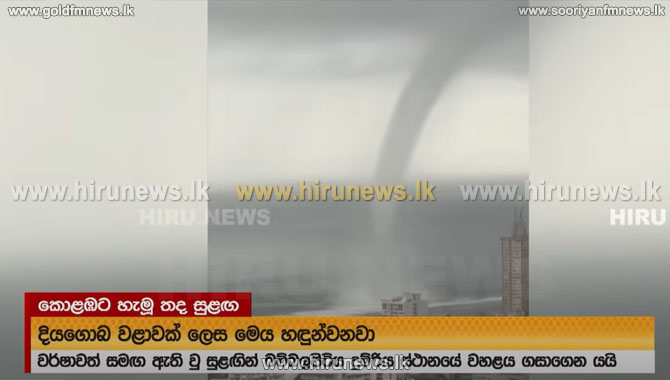
Two passengers sustained injuries when the roof of the Bambalapitiya railway station collapsed during a heavy rain accompanied by strong winds last afternoon. Fortunately, their injuries are reported as non-serious.
In another weather-related incident, a slow train traveling from Badulla to Kandy derailed. This derailment is expected to cause delays for trains operating along the uplcountry route, according to the railway department.
Meanwhile, there has been some speculation whether this was a water spout, just strong winds or a tornado.
Editor's Note:
The primary difference is that waterspouts occur over a body of water whereas tornadoes tend to happen over dry land. Waterspouts are a type of tornado that is usually less powerful and less destructive due to the fact that there is usually less in its path to destroy
A waterspout is a weather phenomenon characterized by a tornado-like column of water that extends from the base of a cloud down to the surface of a body of water, such as the ocean or a lake. Waterspouts are typically associated with severe thunderstorms and can vary in size and intensity.
There are two main types of waterspouts:
Tornadic Waterspouts: These are similar to tornadoes and form in association with severe thunderstorms. They develop from the rotation of a supercell thunderstorm and have a well-defined funnel that extends from the cloud to the water's surface. Tornadic waterspouts can be extremely dangerous and have the potential to cause significant damage if they make landfall.
Fair-Weather Waterspouts: These are generally less intense and occur in fair weather conditions, often over relatively calm waters. They typically have a smaller, less well-defined funnel and are less likely to pose a significant threat to life and property. Fair-weather waterspouts are often short-lived and relatively weak compared to tornadic waterspouts.
Waterspouts are more commonly observed in certain regions with the right meteorological conditions, such as coastal areas and warm, tropical waters. They can be visually striking and are often accompanied by swirling clouds, wind, and water spray.
It's important to note that waterspouts are primarily a marine phenomenon, and while they can be dangerous to boaters and coastal areas, they are generally not as destructive as tornadoes that form over land.
In another weather-related incident, a slow train traveling from Badulla to Kandy derailed. This derailment is expected to cause delays for trains operating along the uplcountry route, according to the railway department.
Meanwhile, there has been some speculation whether this was a water spout, just strong winds or a tornado.
Editor's Note:
The primary difference is that waterspouts occur over a body of water whereas tornadoes tend to happen over dry land. Waterspouts are a type of tornado that is usually less powerful and less destructive due to the fact that there is usually less in its path to destroy
A waterspout is a weather phenomenon characterized by a tornado-like column of water that extends from the base of a cloud down to the surface of a body of water, such as the ocean or a lake. Waterspouts are typically associated with severe thunderstorms and can vary in size and intensity.
There are two main types of waterspouts:
Tornadic Waterspouts: These are similar to tornadoes and form in association with severe thunderstorms. They develop from the rotation of a supercell thunderstorm and have a well-defined funnel that extends from the cloud to the water's surface. Tornadic waterspouts can be extremely dangerous and have the potential to cause significant damage if they make landfall.
Fair-Weather Waterspouts: These are generally less intense and occur in fair weather conditions, often over relatively calm waters. They typically have a smaller, less well-defined funnel and are less likely to pose a significant threat to life and property. Fair-weather waterspouts are often short-lived and relatively weak compared to tornadic waterspouts.
Waterspouts are more commonly observed in certain regions with the right meteorological conditions, such as coastal areas and warm, tropical waters. They can be visually striking and are often accompanied by swirling clouds, wind, and water spray.
It's important to note that waterspouts are primarily a marine phenomenon, and while they can be dangerous to boaters and coastal areas, they are generally not as destructive as tornadoes that form over land.
Latest News
Tokyo urges men to wear shorts to work, but some women say it's 'leg hair harassment'
Local
22 July 2026

Rubio warns of creating 'dangerous precedent' in allowing Iran to control Strait of Hormuz
Local
22 July 2026

Bus fares in England will be capped at £2
Local
22 July 2026

Companies race to deliver autonomous uncrewed fighter jets
Local
22 July 2026
Democrats slam Trump administration over funding for the war on Iran
Local
22 July 2026

Michelin-starred restaurateur faces jail for using ants as dessert garnish
Local
22 July 2026

Trump administration has signed off on civilian nuclear deal with Saudi Arabia, media report
Local
22 July 2026

UN says 400,000 people still displaced in Lebanon
Local
22 July 2026
Trump says China election claims are “old”, vows talks
Local
22 July 2026

Shooting attempt on Templers Road in Mount Lavinia fails
Local
22 July 2026