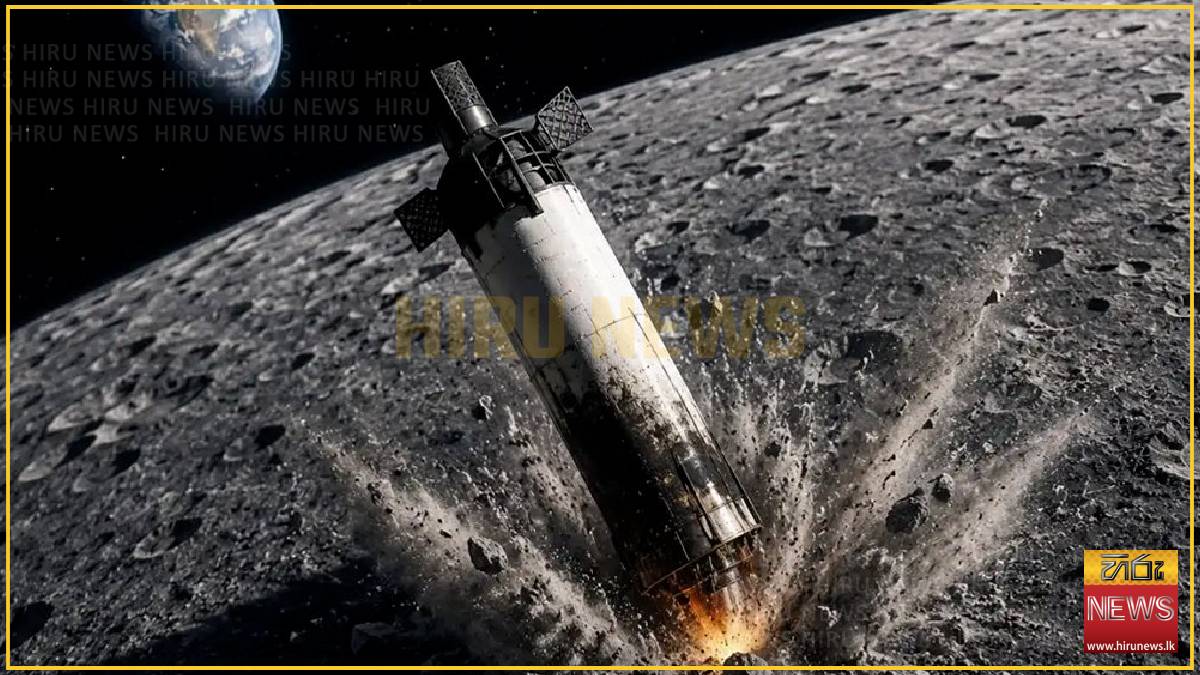


A four-tonne chunk of debris the size of a school bus from a SpaceX rocket has crashed into the Moon, according to tracking data, creating a new crater on the lunar surface and providing scientists a rare look at high-velocity cosmic impacts.
The object, the second stage of a Falcon 9 rocket launched in early 2025, struck the Moon early Wednesday near the Einstein Crater, at approximately 8,700 kilometres per hour (5,400 miles per hour), according to orbital trajectories mapped by independent astronomers and confirmed by space-tracking agencies. It struck the lunar surface with the force of roughly three tonnes of TNT.
Such rocket hardware typically re-enters Earth’s atmosphere to burn up or splash down into remote ocean zones after delivering payloads into orbit.
But over 18 months, gravitational forces exerted by the Sun, Earth, and Moon gradually altered its flight path, setting it on an inevitable collision course. SpaceX said the trajectory leading to the crash was unintentional but unpreventable, given the vehicle’s remaining fuel reserves.
“What has happened is essentially a mixture of solar activity and gravity forces have put it on a path toward the moon,” Julianna Scheiman, SpaceX director of NASA science and Dragon programmes, told reporters on Monday.
Orbital observation craft, including NASA’s Lunar Reconnaissance Orbiter (LRO) and South Korea’s Danuri spacecraft, have adjusted their sensor suites to document the collision site. While the instantaneous flash will be obscured by daylight on the lunar surface, orbiters will survey the ejected dust plume and take high-resolution before-and-after imagery of the newly formed crater.
Space tracking expert Bill Gray told The Associated Press news agency: “It doesn’t present any immediate danger, though it does highlight a certain carelessness about how leftover space hardware is disposed of.” He added that “things are getting crowded up there.”
Wednesday’s collision marks only the second known instance of discarded rocket space debris accidentally crashing into the Moon. The first occurred on March 4, 2022, when part of a Chinese Long March 3C rocket launched in 2014 impacted the lunar far side, carving out an unusual double crater.
-Al Jazeera
Latest News
Nearly 80% of interceptors for a key missile defense system depleted, sources say

Woman arrested after four people stabbed in London’s Covent Garden, police say

Buttler breaks T20 runs record in Super Giants win

Pope Leo to visit Peru, where he served as bishop, as part of first Latin American trip as pontiff

French men get suspended jail sentences over livestreamed death

Israel launches fresh strikes on southern Lebanon amid ceasefire talks in Rome

Vessel sinks off Yemen's coast after attack, UK maritime agency says

Under Patel, FBI forges unprecedented law enforcement ties with China, Russia

Anthropic AI used fake profiles to target people in hack

Iran and Oman reach understanding on coordinates of route through Hormuz, Iran ministry says