



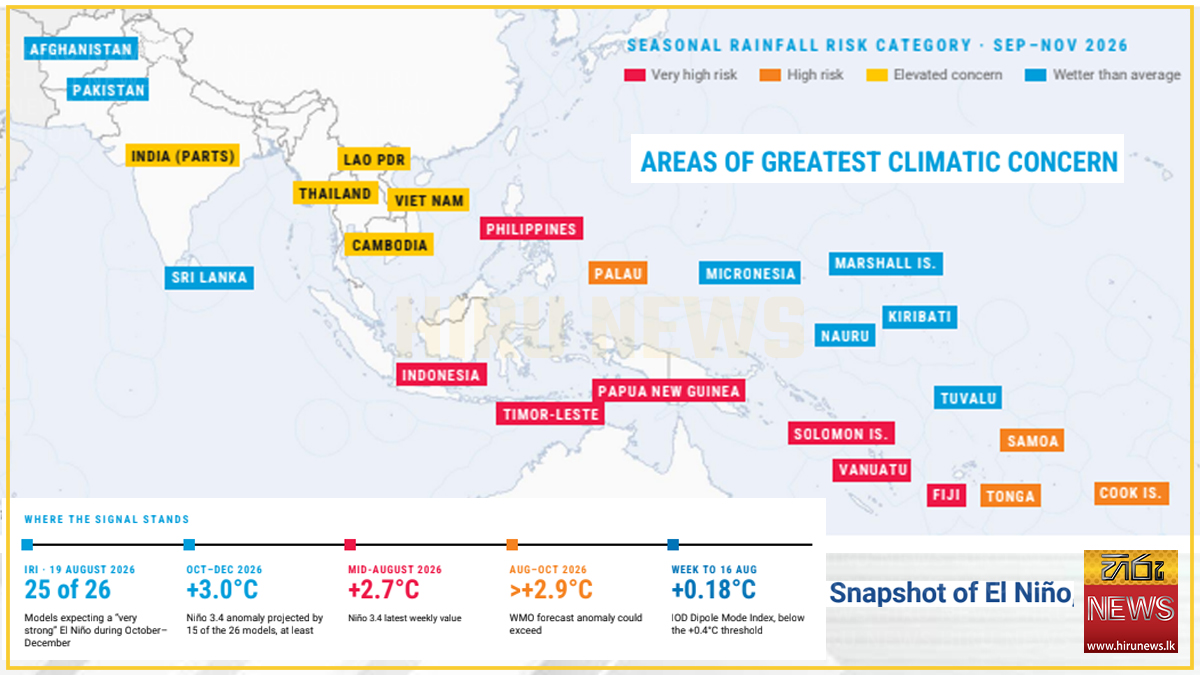


Asia and the Pacific is entering a period of increasingly complex and overlapping risks, with El Niño conditions strengthening while the Indian Ocean Dipole (IOD) continues to fluctuate around neutral to positive levels and is forecast to become more consistently positive from September 2026.
At the same time, renewed pressures linked to the Middle East are adding uncertainty to fuel, fertiliser and food markets and supply chains. The latest forecasts increasingly point towards a very strong, and potentially exceptional, El Niño that could rank among the strongest events in the historical record and may extend well into 2027.
However, its strength alone will not determine the impacts. What matters is where rainfall and temperature anomalies coincide with crop calendars, water scarcity, vulnerable livelihoods and limited coping capacity.
The combined impact could result in an additional 8.2 million people facing acute food insecurity across a number of monitored countries in Asia and the Pacific, with the overall number likely to be higher.
While the risk is already emerging, widespread impacts have not yet materialised, providing a critical but narrowing window for preparedness and anticipatory action. The most serious agricultural and food-security impacts may not emerge until late 2026 and 2027, leaving a short window to act before losses become entrenched.
For Sri Lanka, the wetter signal becomes particularly important from October 2026 onwards, as it coincides with the Second Inter-Monsoon period from October to November, typically the wettest period of the year across the country, followed by the Northeast Monsoon from December to February.
Asia and the Pacific is entering the 2026/27 El Niño episode with significant humanitarian needs already present, while the effects of the Middle East crisis are becoming increasingly embedded in food, fuel and agricultural input systems.
The greatest concern is therefore not climate risk in isolation, but where a strengthening El Niño intersects with existing food insecurity, high import dependence, rising food costs and limited household capacity to absorb another shock.
Over the coming months, these pressures are likely to unfold sequentially, from fuel to fertiliser and then to food systems (3FS).
The convergence risk is particularly relevant as the Maha season begins. Diesel and petrol prices remain around 44% and 41% above pre-crisis levels, respectively, while headline CPI has increased by around 6% (WFP, 2026b).
Sri Lanka is also exposed to fertiliser imports and international wheat markets, while elevated fertiliser prices during 2026 have increased pressure on agricultural production (World Bank, 2026f).
These economic pressures coincide with the country’s principal rice-growing season and a wetter-than-average climate signal, creating the potential for higher input costs and possible fertiliser constraints to interact with heavy rainfall or flooding (FAO, 2026; WMO, 2026b).
Latest News
ICC Women’s Champions Trophy heads to India

Commonwealth Lawyers Association President raises concerns over Supreme Court hearing on 22nd Amendment petitions

Final rites of popular model Chulapadmendra performed

Dhanosh Theekshana Weerasekara secures highest marks in Sinhala medium at Grade 5 Scholarship exam

Eldest son of former Colombo Mayor A. J. M. Muzammil arrested

George Clooney defends Mark Ruffalo over Paramount-Warner deal

King Charles, Macron to preview Bayeux Tapestry

Moscow vows to avoid airspace disruption

Authorities vow action over child abuse linked to exam results

Tom Cruise backs Paramount-Warner Bros. merger