




In December 2025, Cyclone Ditwah struck Sri Lanka, triggering the worst flooding and landslides in recent memory. Over 640 people lost their lives, while 173 remained missing as of January 2026.
In response to the Government of Sri Lanka’s request, the United Nations and its humanitarian partners launched the Humanitarian Priorities Plan (HPP) on 11 December 2025, a coordinated effort to direct international assistance.
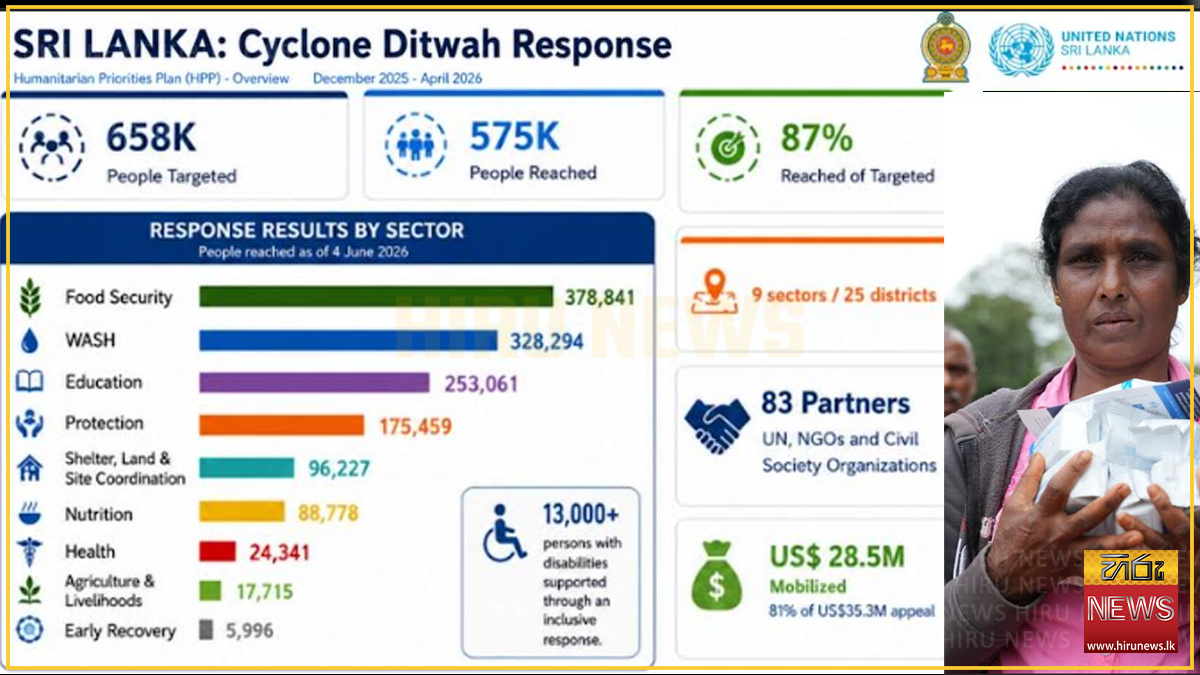
The United Nations and humanitarian partners have now concluded the HPP. To date, critical assistance has been delivered to 575,000 of the most vulnerable people across all 25 districts, with support concentrated in the hardest-hit areas of Badulla, Nuwara Eliya, Kandy, and Kegalle.
Against a total requirement of US$ 35.3 million, the response raised US$ 28.5 million in donor contributions, a testament to the international community’s confidence in the country and its solidarity with the people of Sri Lanka.
The response was made possible thanks to Australia, the United Nations Central Emergency Response Fund, the United States, Japan, the European Union, Norway, Canada, the Gates Foundation, the United Kingdom, New Zealand, the Republic of Korea, Cyprus, and Switzerland.
Additional contributions came through UNICEF National Committees in the United States and Germany, the UNICEF Global Thematic Emergency Response Fund, the National Union of Public and General Employees Canada, FAO’s Special Fund for Emergency and Resilience Activities, and emergency financing mechanisms of WHO, UNESCO, and UNDP.
The international humanitarian response extended well beyond the HPP. Over 20 countries contributed financial bilateral assistance, while 19 countries deployed search and rescue teams or provided in-kind and technical support, reflecting the breadth of international solidarity with Sri Lanka.
The HPP provided cash assistance to affected families, complementing the Government’s own cash assistance programme, as well as transitional shelters to displaced households, while ensuring access to safe water and sanitation in temporary settlements.
“The partnership demonstrated through the Humanitarian Priorities Plan has shown that Sri Lanka can respond more effectively when we act together, with clarity of purpose and respect for each other’s roles,” said Prabath Chandrakeerthi, Commissioner General of Essential Services.
“From the very first days, humanitarian partners and the government worked shoulder to shoulder, from the national level to the most affected villages. The international community rallied, and the resilience and solidarity shown by the Sri Lankan people themselves was nothing short of inspiring,” said Marc-André Franche, United Nations Resident Coordinator in Sri Lanka.
Even as the humanitarian response concludes, the scale of the recovery challenge is becoming clearer.
The Government’s Post-Disaster Needs Assessment estimates resilient recovery and reconstruction needs at US$ 3.4 billion. An estimated 113,000 homes were damaged or destroyed, with the heaviest toll falling on those already most vulnerable, including women, children, plantation communities, and informal workers, many of whom were still recovering from the 2022 economic crisis.
Latest News
Public warned against digital identity card scam
No approval yet for judges’ retirement age change, says Justice Minister
Sri Lanka eyes sea-water purification amid El Niño risk

UK minister says violence in Northern Ireland is racist thuggery
EU agrees stronger price controls for new carbon market

Kuwait restores air traffic after temporary closure

Police allowance deposited twice due to error

UN and partners raise US$ 28.5mn in donor contributions for Cyclone Ditwah
India urges UN to review sanctions on Afghanistan
GPI warns Sri Lanka at risk of energy shocks