


Share Post


London has an unexploded bomb in its backyard.
If it goes off, it will result in a blast twice as big as that which levelled parts of Beirut in 2020.
Russian President Vladimir Putin knows this. His propagandists, Dr Andrey Sidorov and Vladimir Solovyov, told Russian TV that this is a sitting duck, just waiting to be sabotaged.
Which is why Londoners will be watching on nervously as maritime engineers and Royal navy divers begin hacking away at a shipwreck containing 1500 tonnes of unexploded ordnance later this month.
They will be attempting to remove the rusted derricks (cargo crane masts) teetering out of the water from a sunken World War II ammunition ship.Their collapse could trigger the deadly cargo below.
A Ministry of Defence study from as far back as the 1970s warned this could send a mushroom cloud of water, steel debris and mud 3km high into the sky. The catastrophic 7km blast radius encompasses parts of Kent, Essex – and Britain’s largest Liquefied Natural Gas terminal.
And an unstoppable 5m tall tsunami wave could surge up the adjoining Medway Approach Channel and into the Thames River, swamping shipping, port facilities, seaside suburbs and towns.
This should surprise no one.
Nicknamed the “doomsday wreck”, the remains of the Liberty Ship SS Richard Montgomery has sat on the seabed in the Thames Estuary since August 1944.
The threat it poses has been public knowledge ever since.
Nobody’s done anything about it.
Except mother nature.
“Ignore it, and it will go away” has proven a failed containment strategy.
And the favoured policy of successive UK governments of “kicking the can down the road” is rapidly running out of road.
Recent surveys reveal the wreck’s deterioration has accelerated. Its rust-weakened hull is being levered apart by tides, storms and passing ship wakes.
It’s starting to collapse.
Danger: UXB
Kremlin propagandist Vladimir Solovyov was discussing retaliatory measures for Ukraine’s attacks on Russian oil terminals in October last year.
“The oil refineries in the Netherlands must burn,” he said.
“They must all be destroyed. Everything they have must burn.”
Then, Kremlin historian Dr Andrey Sidorov proposed targeting the SS Richard Montgomery.
“There are 1400 tonnes of explosives there. They say it’s still active. The masts are sticking out. If you hit it, this will flood all the coastal villages and ports,” Dr Sidorov explained.
“So we need to start with that, today … Just don’t accuse me of terrorism.”
Russian “Shadow” (illegal) fleet tankers and cargo ships regularly pass through the English Channel.
European intelligence agencies believe these are the source of mysterious drone incursions over critical infrastructure, including airports, military bases and power plants.
The British government recently enacted a one nautical mile (1.9km) drone exclusion zone around the wreck.
“The wreck is at risk of drone sabotage because it is a fixed, conspicuous target,” retired paratrooper Andrew Fox warned The Telegraph in March.
Former British Army intelligence officer Colonel Phillip Ingram told the MailOnline that the real risk was of a hostile state taking advantage of the wreck: “They could do it underwater from afar with a submersible bomb”.
Russia is unlikely to observe the exclusion zone. Nor is any other hostile nation, extremist group or terrorist organisation.
And a busy cargo shipping channel runs immediately adjacent to the wreck.
This itself poses a risk of collision.
Accidents happen.
In March last year, the container ship Solong collided with the anchored fuel tanker Stena Immaculate, some 150km from the wreck. The 59-year-old captain of the Solong (a Russian national) was arrested on charges of gross negligence manslaughter.
Some safety measures are in place.
Rusting red warning signs are affixed to the wreck’s masts.
A ring of buoys outlines the prohibited waters.
New maps show the aircraft “no-fly” zone established in June last year.
And radar surveillance keeps a steady watch.
“Our priority will always be to ensure the safety of the public and to reduce any risk posed by the SS Richard Montgomery,” a Department for Transport spokesman said.
“We have been clear that pilots and operators, including drones, must not fly in a limited area around and above the site, which is standard for no-fly zones across the country.”
Casualty of war
The story of the SS Richard Montgomery is much like that of hundreds of other World War II ships.
What makes her different is where she rests.
The Liberty Ship project was designed to build as many ships as quickly and cheaply as possible. The impending invasion of France demanded mountains of supplies. And ships were being sunk by U-boats faster than they were being built.
The 440 foot (135 metre) SS Richard Montgomery was one of 2700 examples of the standardised design mass-produced to address this.
In August, 1944, the American-flagged cargo ship was loaded to the brim with a staggering 7000 tons of munitions for the war effort.
She survived the loading process.
She survived running the Atlantic Convoy gauntlet.
She arrived in British waters and prepared to make the crossing to Normandy.
But a storm struck while the Montgomery waited at Sheerness in the shallow Thames Estuary. On August 20, the anchor dragged on the sandbank and the ship grounded.
Urgent salvage work swung into action.
Maritime authorities knew the cargo was desperately needed on the Western Front. But they also knew how dangerous it was.
But they were only able to recover about half before the ship began to break up and sink a few weeks later.
Estimates vary. But some 1400 to 1500 tonnes of explosives are believed to remain in its forward cargo hold. This includes 14,570 450kg bombs, 230kg cluster bombs and white-phosphorus incendiary devices.
It was recommended in 2020 that the wreck’s masts be removed because they were placing extra strain on the cargo hold containing the explosive.
Six years later, the British government has been forced into action.
Successive annual surveys have found the SS Richard Montgomery is collapsing in on itself.
And that collapse is accelerating.
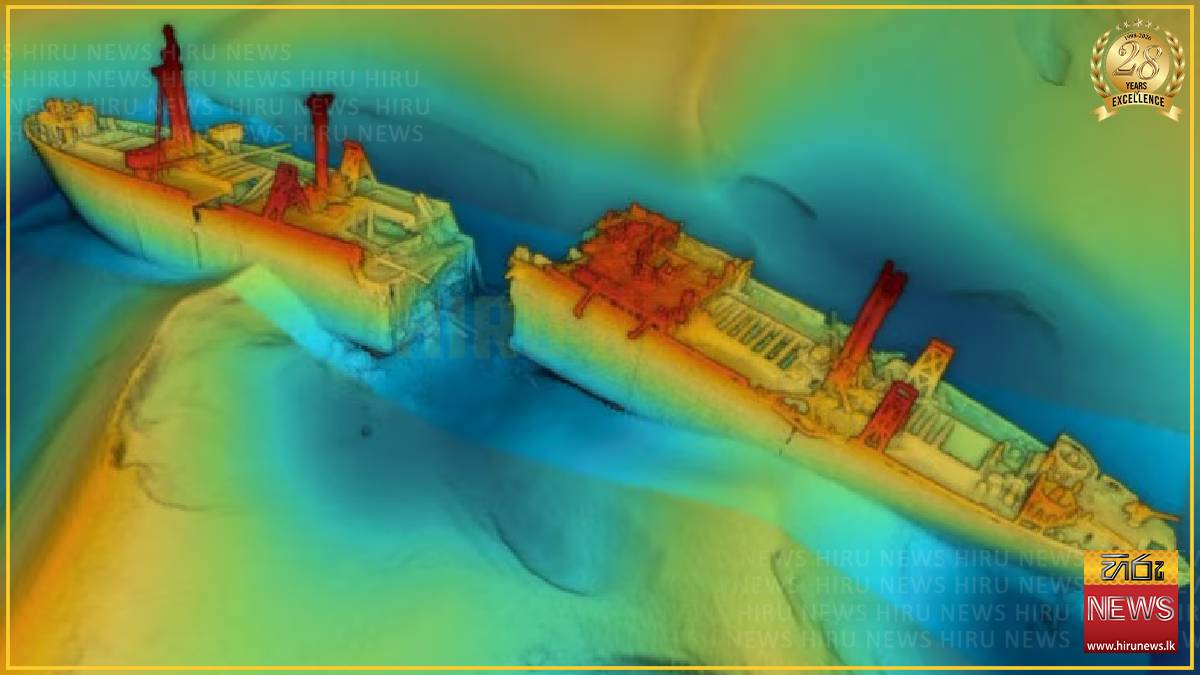
The ship broke in two when it sank.
Now, the front half is tipping over – moving some 50cm in the past two years. An upper side deck is splitting. The opposite lower-side deck has “significantly buckled”.
The deck above the cargo hold containing the explosive has sagged some 17cm in 12 months.
“Experts are continuing to monitor the site, and we have appointed leading salvage company Resolve Marine to undertake the mast removal project,” the Department for Transport said to reassure nearby residents.
Fallout zone
The town and port of Sheerness are immediately opposite the SS Richard Montgomery wreck.
It’s something of a local landmark.
The 13,000 residents stare at the Liberty Ship’s three cargo masts daily with a mix of fascination and fear.
It’s also good for business.
A town mural shows a mermaid resting against a detonator marked TNT”. Several local businesses have adopted old “Monty’s” name.
But the risk the ammunition ship poses is real.
The accidental detonation of 2700 tons of ammonium nitrate, a chemical used to make fertiliser and bombs, in Beirut produced a blast equivalent to 1000 tons of TNT explosive.
That blast killed 218 people, injured 7000 and forced 300,000 to evacuate. Total economic fallout is estimated at $US20 billion, including $US4.6 billion in infrastructure damage.
Ammunition ships have exploded before.
A 1967 salvage attempt on the wreck of the Polish ammunition carrier Kielce in the English Channel ended in failure. The resulting explosion measured 4.5 on the Richter earthquake scale, and the nearby town of Folkestone was seriously rattled. Nobody died in the accident.
Unexploded bombs are still a serious problem.
An attempt to remove a Royal Air Force “Talboy” 12,000-pound (5500kg) “earthquake bomb” from the Piast Canal last year accidentally triggered the weapon. Nobody was hurt as the area had been evacuated as a precaution.
Now, navy divers will attempt to remove the USS Richard Montgomery’s masts to prevent them from falling on the deadly cargo below.
They were “trimmed” in 1999 to reduce stress on the hull below. But, 27 years later, the threat is back.
Now new safety measures involve constructing an underwater platform to brace the masts in place before being cut loose.
If they survive, the masts – still the property of the United States under international law – will then be lifted to The Historic Dockyard Chatham for preservation.
“I’m delighted the United States has agreed to hand over the Montgomery masts so they can be put on public display on Sheppey,” local MP Kevin McKenna told KentOnline.
“These iconic structures have been part of Sheppey’s story for generations, and I’m proud that future generations will be able to see them, learn from them, and celebrate their place in our history.”
-news.com.au
If it goes off, it will result in a blast twice as big as that which levelled parts of Beirut in 2020.
Russian President Vladimir Putin knows this. His propagandists, Dr Andrey Sidorov and Vladimir Solovyov, told Russian TV that this is a sitting duck, just waiting to be sabotaged.
Which is why Londoners will be watching on nervously as maritime engineers and Royal navy divers begin hacking away at a shipwreck containing 1500 tonnes of unexploded ordnance later this month.
They will be attempting to remove the rusted derricks (cargo crane masts) teetering out of the water from a sunken World War II ammunition ship.Their collapse could trigger the deadly cargo below.
A Ministry of Defence study from as far back as the 1970s warned this could send a mushroom cloud of water, steel debris and mud 3km high into the sky. The catastrophic 7km blast radius encompasses parts of Kent, Essex – and Britain’s largest Liquefied Natural Gas terminal.
And an unstoppable 5m tall tsunami wave could surge up the adjoining Medway Approach Channel and into the Thames River, swamping shipping, port facilities, seaside suburbs and towns.
This should surprise no one.
Nicknamed the “doomsday wreck”, the remains of the Liberty Ship SS Richard Montgomery has sat on the seabed in the Thames Estuary since August 1944.
The threat it poses has been public knowledge ever since.
Nobody’s done anything about it.
Except mother nature.
“Ignore it, and it will go away” has proven a failed containment strategy.
And the favoured policy of successive UK governments of “kicking the can down the road” is rapidly running out of road.
Recent surveys reveal the wreck’s deterioration has accelerated. Its rust-weakened hull is being levered apart by tides, storms and passing ship wakes.
It’s starting to collapse.
Danger: UXB
Kremlin propagandist Vladimir Solovyov was discussing retaliatory measures for Ukraine’s attacks on Russian oil terminals in October last year.
“The oil refineries in the Netherlands must burn,” he said.
“They must all be destroyed. Everything they have must burn.”
Then, Kremlin historian Dr Andrey Sidorov proposed targeting the SS Richard Montgomery.
“There are 1400 tonnes of explosives there. They say it’s still active. The masts are sticking out. If you hit it, this will flood all the coastal villages and ports,” Dr Sidorov explained.
“So we need to start with that, today … Just don’t accuse me of terrorism.”
Russian “Shadow” (illegal) fleet tankers and cargo ships regularly pass through the English Channel.
European intelligence agencies believe these are the source of mysterious drone incursions over critical infrastructure, including airports, military bases and power plants.
The British government recently enacted a one nautical mile (1.9km) drone exclusion zone around the wreck.
“The wreck is at risk of drone sabotage because it is a fixed, conspicuous target,” retired paratrooper Andrew Fox warned The Telegraph in March.
Former British Army intelligence officer Colonel Phillip Ingram told the MailOnline that the real risk was of a hostile state taking advantage of the wreck: “They could do it underwater from afar with a submersible bomb”.
Russia is unlikely to observe the exclusion zone. Nor is any other hostile nation, extremist group or terrorist organisation.
And a busy cargo shipping channel runs immediately adjacent to the wreck.
This itself poses a risk of collision.
Accidents happen.
In March last year, the container ship Solong collided with the anchored fuel tanker Stena Immaculate, some 150km from the wreck. The 59-year-old captain of the Solong (a Russian national) was arrested on charges of gross negligence manslaughter.
Some safety measures are in place.
Rusting red warning signs are affixed to the wreck’s masts.
A ring of buoys outlines the prohibited waters.
New maps show the aircraft “no-fly” zone established in June last year.
And radar surveillance keeps a steady watch.
“Our priority will always be to ensure the safety of the public and to reduce any risk posed by the SS Richard Montgomery,” a Department for Transport spokesman said.
“We have been clear that pilots and operators, including drones, must not fly in a limited area around and above the site, which is standard for no-fly zones across the country.”
Casualty of war
The story of the SS Richard Montgomery is much like that of hundreds of other World War II ships.
What makes her different is where she rests.
The Liberty Ship project was designed to build as many ships as quickly and cheaply as possible. The impending invasion of France demanded mountains of supplies. And ships were being sunk by U-boats faster than they were being built.
The 440 foot (135 metre) SS Richard Montgomery was one of 2700 examples of the standardised design mass-produced to address this.
In August, 1944, the American-flagged cargo ship was loaded to the brim with a staggering 7000 tons of munitions for the war effort.
She survived the loading process.
She survived running the Atlantic Convoy gauntlet.
She arrived in British waters and prepared to make the crossing to Normandy.
But a storm struck while the Montgomery waited at Sheerness in the shallow Thames Estuary. On August 20, the anchor dragged on the sandbank and the ship grounded.
Urgent salvage work swung into action.
Maritime authorities knew the cargo was desperately needed on the Western Front. But they also knew how dangerous it was.
But they were only able to recover about half before the ship began to break up and sink a few weeks later.
Estimates vary. But some 1400 to 1500 tonnes of explosives are believed to remain in its forward cargo hold. This includes 14,570 450kg bombs, 230kg cluster bombs and white-phosphorus incendiary devices.
It was recommended in 2020 that the wreck’s masts be removed because they were placing extra strain on the cargo hold containing the explosive.
Six years later, the British government has been forced into action.
Successive annual surveys have found the SS Richard Montgomery is collapsing in on itself.
And that collapse is accelerating.
The ship broke in two when it sank.
Now, the front half is tipping over – moving some 50cm in the past two years. An upper side deck is splitting. The opposite lower-side deck has “significantly buckled”.
The deck above the cargo hold containing the explosive has sagged some 17cm in 12 months.
“Experts are continuing to monitor the site, and we have appointed leading salvage company Resolve Marine to undertake the mast removal project,” the Department for Transport said to reassure nearby residents.
Fallout zone
The town and port of Sheerness are immediately opposite the SS Richard Montgomery wreck.
It’s something of a local landmark.
The 13,000 residents stare at the Liberty Ship’s three cargo masts daily with a mix of fascination and fear.
It’s also good for business.
A town mural shows a mermaid resting against a detonator marked TNT”. Several local businesses have adopted old “Monty’s” name.
But the risk the ammunition ship poses is real.
The accidental detonation of 2700 tons of ammonium nitrate, a chemical used to make fertiliser and bombs, in Beirut produced a blast equivalent to 1000 tons of TNT explosive.
That blast killed 218 people, injured 7000 and forced 300,000 to evacuate. Total economic fallout is estimated at $US20 billion, including $US4.6 billion in infrastructure damage.
Ammunition ships have exploded before.
A 1967 salvage attempt on the wreck of the Polish ammunition carrier Kielce in the English Channel ended in failure. The resulting explosion measured 4.5 on the Richter earthquake scale, and the nearby town of Folkestone was seriously rattled. Nobody died in the accident.
Unexploded bombs are still a serious problem.
An attempt to remove a Royal Air Force “Talboy” 12,000-pound (5500kg) “earthquake bomb” from the Piast Canal last year accidentally triggered the weapon. Nobody was hurt as the area had been evacuated as a precaution.
Now, navy divers will attempt to remove the USS Richard Montgomery’s masts to prevent them from falling on the deadly cargo below.
They were “trimmed” in 1999 to reduce stress on the hull below. But, 27 years later, the threat is back.
Now new safety measures involve constructing an underwater platform to brace the masts in place before being cut loose.
If they survive, the masts – still the property of the United States under international law – will then be lifted to The Historic Dockyard Chatham for preservation.
“I’m delighted the United States has agreed to hand over the Montgomery masts so they can be put on public display on Sheppey,” local MP Kevin McKenna told KentOnline.
“These iconic structures have been part of Sheppey’s story for generations, and I’m proud that future generations will be able to see them, learn from them, and celebrate their place in our history.”
-news.com.au
Latest News
India, South Africa to boost their strategic petroleum reserves
Local
17 July 2026
'The Grand Tour' to return this September with three new presenters
Local
17 July 2026

CAA imposes strict packaging standards for soap
Local
17 July 2026

How an Italian sculptor created the World Cup trophy that became an icon
Local
17 July 2026
Fears ‘doomsday’ WWII shipwreck could unleash Beirut-level blast as removal mission begins
Local
17 July 2026
Mosvold Martinus Foundation and Western PC sign MoU to strengthen early childhood education
Local
17 July 2026

People in many countries view China more positively than the US
Local
17 July 2026

Commercial Bank debenture issue oversubscribed, closes on first day
Local
17 July 2026

India is becoming the world's refining swing producer
Local
17 July 2026
Ather showcases Innovation at Colombo EV Motor Show
Local
17 July 2026