



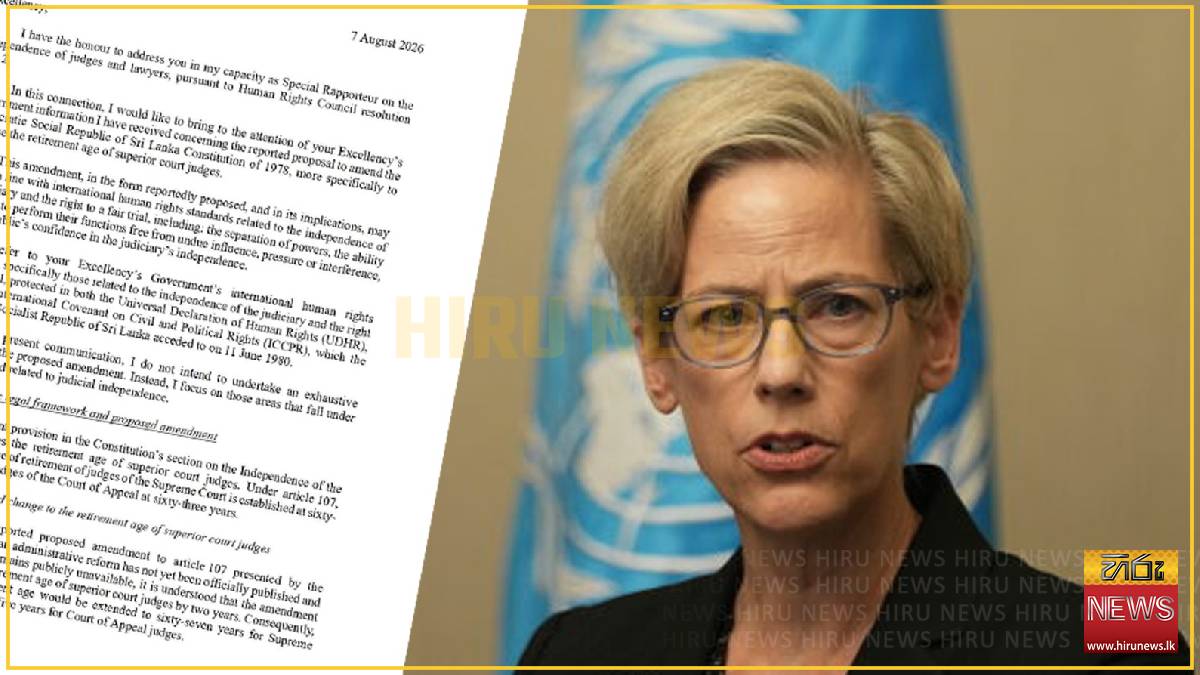


The United Nations has voiced critical concern regarding a proposed constitutional amendment by the Sri Lankan government aimed at extending the retirement age of superior court judges. In an official communication to the President, Margaret Satterthwaite, the UN Special Rapporteur on the independence of judges and lawyers, warned that the proposal threatens judicial independence, the separation of powers, and the fundamental right to a fair trial.
Introduced by the Minister of Justice as an administrative reform, the amendment proposes raising the mandatory retirement limits set under Article 107 of the Constitution—moving the cap from 65 to 67 years for Supreme Court judges, and from 63 to 65 years for Court of Appeal judges.
The primary focus of international concern centers on the scope of the proposed policy: rather than applying solely to future judicial appointees, the extension would alter the terms of currently sitting judges.
The UN expert emphasized Sri Lanka’s international commitments under the Universal Declaration of Human Rights and the International Covenant on Civil and Political Rights (ICCPR), to which the country acceded in 1980. Grounding her position on Article 14 of the ICCPR and the UN Basic Principles on the Independence of the Judiciary, Satterthwaite highlighted that secure judicial tenure is essential to insulating the judiciary from political pressures and executive interference. Applying ad hoc changes to current tenures risks creating the perception that the composition of the courts is being manipulated for immediate individual or institutional benefit.
Furthermore, the Special Rapporteur warned of severe institutional conflicts of interest. Under Article 121 of the Constitution, sitting judges extended in office by the amendment could ultimately be tasked with ruling on the constitutional validity of the legislation itself. The lack of transitional frameworks or protective safeguards to manage these potential conflicts threatens to severely undercut public trust in the judiciary's impartiality.
To safeguard the rule of law, the Special Rapporteur urged that any adjustments to judicial retirement limits occur through a transparent, inclusive, and systemic reform of the justice sector. She requested that the Sri Lankan government submit clarifications on the text of the amendment, detail the justification for applying extensions to active judges, and outline explicit measures to protect public confidence and shield the judiciary from executive overreach.
Latest News
More fans are tuning into women’s sports, Nielsen report finds

Italy's Curtis betters own 50m backstroke world record

Dominican Republic expels 9 Cuban officials
USS George Washington headed to Middle East to replace USS Abraham Lincoln

Ukraine offers Russia truce in Black Sea as food supply fears mount, source says

Yemen at highest risk of major conflict since 2022 truce, UN warns

Sri Lanka receives Euro 139 million tax relief via GSP+ in 2024: conditions tighten in 2027

Sell Ukraine 10% of US Patriots and ‘we will destroy all the Russians’ ballistic missiles,’ Zelensky tells CNN
Taiwan throttles mobile internet speeds in defence drill

Bangladesh dominate Australia despite Smith reprieve