



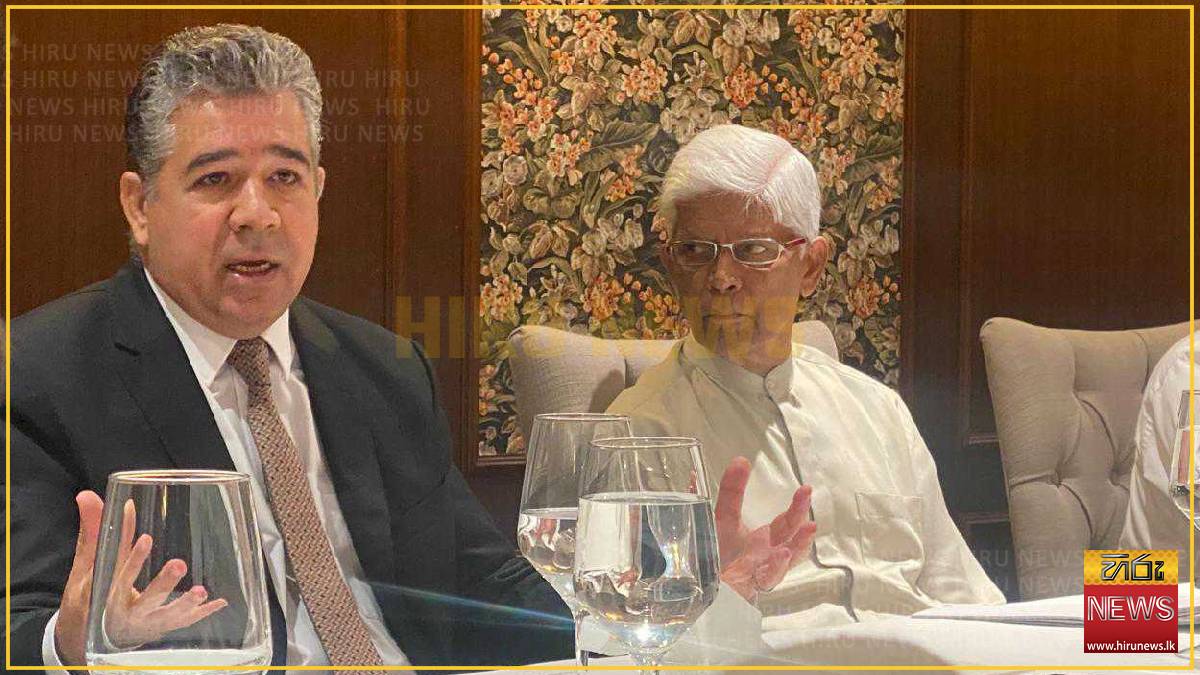


Sri Lanka’s investment climate, bilateral trade, and regional stability were among the key topics discussed by the Ambassador of Türkiye to Sri Lanka, Dr Semih Lütfü Turgut, during a Roundtable discussion organised by the Pathfinder Foundation in Colombo.
Addressing both local and global issues, Ambassador Turgut highlighted the impact of perennial domestic challenges on Sri Lanka’s investment environment.
“First, the market is small compared to other regional countries. Second, bureaucracy is somewhat complex and time-consuming. Additionally, the domestic market is limited, and there is a growing challenge: skilled manpower is moving abroad. In the near future, you may face labour shortages due to this outflow of skilled workers,” he said.
He also voiced concern over the rising price of Sri Lankan tea, noting that it could affect trade relations with Türkiye.
“The main item in our bilateral trade is tea. However, your tea is becoming increasingly expensive, and your markets are being captured by Kenya. This, I have observed, is a negative trend in our bilateral relations,” he explained.
Regional instability and the Middle East
Ambassador Turgut also discussed geopolitical tensions in the Middle East and their potential implications for Sri Lanka.
“The Middle East, long regarded as a focal point of global instability, remains central to Turkey, and it is a very important region for us. It is also important for Sri Lanka, as you have thousands of workers and maintains close commercial and trade relations. Turkey and Sri Lanka should closely monitor developments in the region. This is a geographical area where we can share our views and cooperate more closely,” he said.
He criticised Israel’s actions in the region, describing them as destabilising.
“We have seen that Israel is trying to act as a regional hegemon. But to become a regional hegemon, a country first needs both the will and the resources. Resources refer to military power. However, a regional hegemon does not rely solely on force; it uses both carrots and sticks simultaneously. An analysis of Israel’s power shows that, in the current situation, it lacks economic strength and cultural influence to function as a true hegemon in the region. While its actions may destabilise the region, they do not create order. A regional hegemon, when challenging the existing order, should also provide a path toward stability. Israel, in contrast, is destructive rather than constructive,” he remarked.
The Ambassador also singled out Israeli Prime Minister Benjamin Netanyahu over the war in Gaza.
“He is a corrupt politician. This is a known fact. Even before and after the attacks, thousands of protesters opposed Netanyahu, and yet, despite all those atrocities, he could not unite the Israeli people. Do you think anyone believes that Israel was unaware of all the preparations Hamas carried out? That goes against logical thinking—they are certainly capable. In fact, they may have allowed Hamas to act, and perhaps, through their back channels, signalled, ‘Go ahead with the attack; we will handle the situation ourselves, strengthen our position in Israel, and you will gain something.’ Israel is, in a way, using the Palestinians through certain methods,” he said.
Opportunities for collaboration
Despite challenges, Ambassador Turgut highlighted areas where Sri Lanka and Türkiyecould strengthen collaboration.
“Tourism is one of the sectors we should focus on. Another is textiles, where there could be strategic partnerships between Turkish and Sri Lankan garment producers. Additionally, certain electrical and electronic products are sectors where we are also exploring opportunities,” he noted.
He emphasised the potential for growth in tourism, pointing to a steady rise in Turkish tourist arrivals to Sri Lanka.
Latest News
Turkish Ambassador highlights Sri Lanka’s investment challenges and regional concerns
Russia, Ukraine and US hold talks in Abu Dhabi
Gov to consider pension scheme for private and semi-government sectors
Trump launches Board of Peace
Can Donald Trump buy Greenland?
Russia-China cooperation in Arctic is a concern for NATO
Royal Navy tails Russian warship and tanker
Poland sends power generators to Ukraine
Putin says who owns Greenland is of no concern to Russia
US's largest heist suspect avoids jail by getting deported