


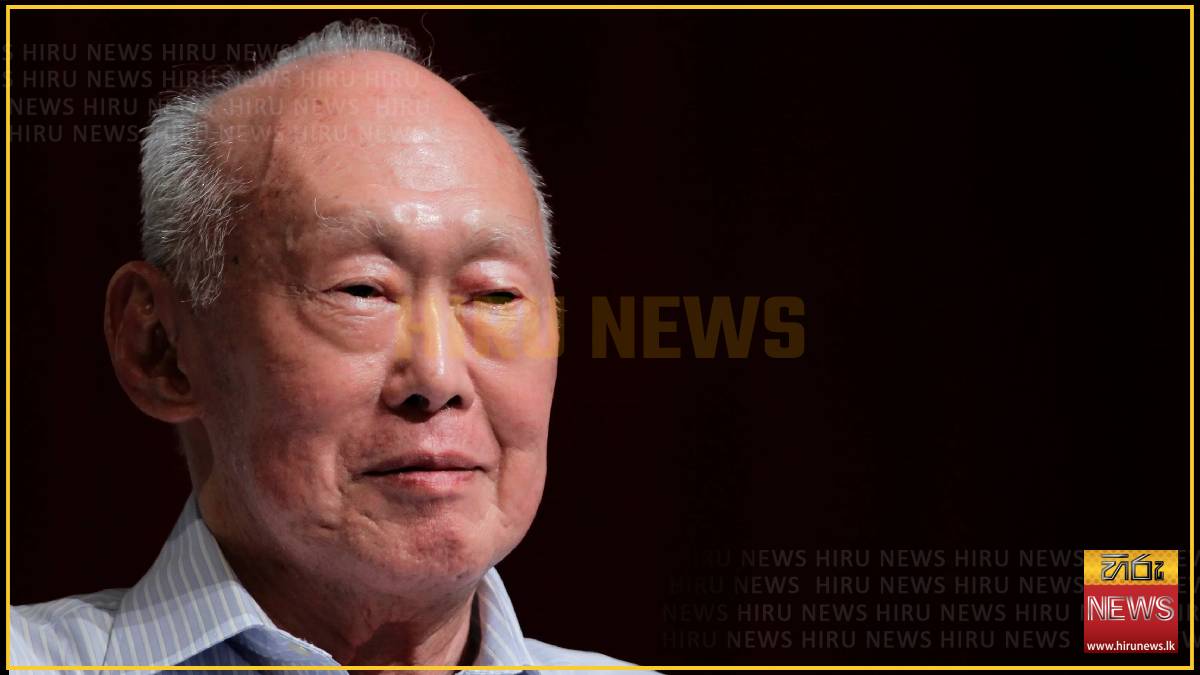


On Singapore’s 61st National Day, Professor Rohan Gunaratna pays tribute to Lee Kuan Yew, Singapore’s founding father, recalling his personal encounters with the statesman and his remarkable foresight on terrorism, regional security and the future of Southeast Asia.
Gunaratna, Professor of Security Studies at Nanyang Technological University, first met Lee Kuan Yew at the Istana in October 2002, just weeks before the Bali bombings that would become Southeast Asia’s deadliest terrorist attack at the time.
He recalls the meeting as being less like a conventional political discussion and more like a conversation between a teacher and a student.
“His mind was razor sharp,” Gunaratna recalls, noting that Lee asked him around 30 questions during their hour-long meeting.
At the time, Prof. Gunaratna had moved from St Andrews University in Scotland to Singapore because he believed Southeast Asia would become a major theatre for Al Qaeda-linked operations.
During the meeting, Lee asked him to assess the region’s emerging terrorist threat.
Prof. Gunaratna warned that terrorists were planning attacks against entertainment venues in Southeast Asia.
Lee initially disagreed, predicting instead that terrorists would focus their efforts in the Middle East, particularly on attempts to gain control of oil fields and influence Western politics.
But Prof. Gunaratna then presented intelligence indicating that senior Al Qaeda and Jemaah Islamiyah figures had been involved in surveillance of targets in Singapore and were preparing for attacks in the region.
According to Prof. Gunaratna, Lee immediately understood the seriousness of the warning.
A warning before Bali
That evening, Lee’s Principal Private Secretary, Andrew Tan, contacted Prof. Gunaratna and asked him to send the Singaporean leader a written assessment of the threat.
Based on intelligence briefings involving a foreign terrorist fighter connected to 9/11 mastermind Khalid Sheikh Mohammed, Prof. Gunaratna warned that an attack in the region could be imminent.
The intelligence indicated that terrorists were considering attacks against entertainment venues including bars, nightclubs and restaurants.
Just two weeks later, Southeast Asia was shaken by the Bali bombings of October 12, 2002.
The Jemaah Islamiyah attacks on the Paddy’s Pub and Sari Club area in Bali killed 202 people and injured hundreds more.
Prof. Gunaratna travelled to Bali to assist Indonesian and Australian colleagues.
When he later met Lee again at the Istana, the Singaporean leader made his priority clear.
“My highest priority is to protect Singapore,” Lee told him, according to Gunaratna.
Preventing Southeast Asia from becoming a second front
The discussions that followed focused on a fundamental question: how could Singapore protect itself from a terrorist threat that extended far beyond its borders?
Prof. Gunaratna argued that Singapore’s security was inseparable from the security of the wider region.
He warned that terrorists wanted to turn Southeast Asia into a “second front” and that regional leaders needed to adopt a zero-tolerance approach to terrorism.
Because Singapore had limited strategic depth, he argued, its long-term security depended heavily on developments in neighbouring countries, particularly Indonesia.
Lee subsequently engaged political leaders across Southeast Asia and beyond, seeking greater cooperation against terrorist networks.
For Prof. Gunaratna, this demonstrated one of Lee’s defining characteristics: he understood that Singapore’s national security could not be separated from regional security.
Lee and the Iraq War
Prof. Gunaratna also recalls discussions with Lee before the 2003 US-led invasion of Iraq.
When Lee sought his assessment, Prof. Gunaratna opposed the invasion, warning that the destruction of Iraq could mobilise, radicalise and militarise vulnerable communities in Southeast Asia.
He also argued that there was no established relationship between Saddam Hussein and Osama bin Laden.
Prof. Gunaratna subsequently published an opinion article in The New York Times in February 2003 arguing that there was no evidence of an alliance between Iraq and Al Qaeda.
In his view, the invasion represented a lost opportunity in the global fight against terrorism, as the subsequent violence and counter-violence contributed to radicalisation across different regions.
A legacy built on security and foresight
Lee Kuan Yew did not live to see later terrorist developments such as the 2016 Batam plot targeting Singapore or the 2017 siege of Marawi in the Philippines.
However, Prof. Gunaratna argues that Lee’s earlier efforts helped establish an enduring understanding among regional governments that terrorism could only be defeated through cooperation.
He describes Singapore as a small country with an outsized strategic influence, arguing that Lee’s diplomacy, security policies and emphasis on national preparedness helped prevent Southeast Asia from becoming a major terrorist theatre.
Beyond security, Prof. Gunaratna credits Lee with transforming Singapore from a developing country into a developed economy, building a professional civil service, confronting corruption and nurturing talented leaders.
He compares Lee’s leadership during Singapore’s formative years with that of historical figures such as Franklin D. Roosevelt and Winston Churchill, who guided their countries through periods of profound crisis.
“He could see far”
For Prof. Gunaratna, Lee’s greatest strength was his ability to look beyond immediate political calculations.
He recalls that Lee sought to work with the United States while simultaneously engaging China, believing in the importance of a peaceful rise of China.
Prof. Gunaratna also points to a prediction Lee made during their 2002 discussions concerning terrorism and the Middle East. The later rise of the Islamic State and its seizure of territory and oil fields in Iraq and Syria, he argues, echoed the concerns Lee had expressed more than a decade earlier.
Ultimately, Prof. Gunaratna describes Lee as a leader who understood the importance of confronting reality rather than avoiding it.
“He saw things as they are,” Prof. Gunaratna writes, and acted to build institutions and educate citizens capable of keeping Singapore safe.
On Singapore’s 61st National Day, his message is therefore not simply a tribute to a former leader. It is also a reflection on the value of strategic foresight, strong institutions and regional cooperation in confronting threats that do not respect national borders.
For Prof. Gunaratna, Lee Kuan Yew remains a statesman whose influence extended far beyond Singapore—and whose vision continues to shape the way Southeast Asia approaches national and regional security.
Latest News
NCE connects Northern exporters with regional businesses
Netanyahu says Israel won't pull out of Gaza before Hamas disarms
Fernandez secures dominant British MotoGP victory

Swiss Re warns on heatwave risks as parts of Germany loosen trucking curbs

Lankan chef Janaka earns Worldchefs Master Pastry Chef credential
Five killed in Ukrainian drone attack on Belgorod, Russian authorities say
Fulham agree £30m fee for Southampton's Charles

Yemeni armed forces say they repelled Houthi attack on Mocha
India's Maruti sees passenger vehicle market rising to up to 6.3 mn units by 2031

Iran's President recently met Supreme Leader Khamenei, state media says