



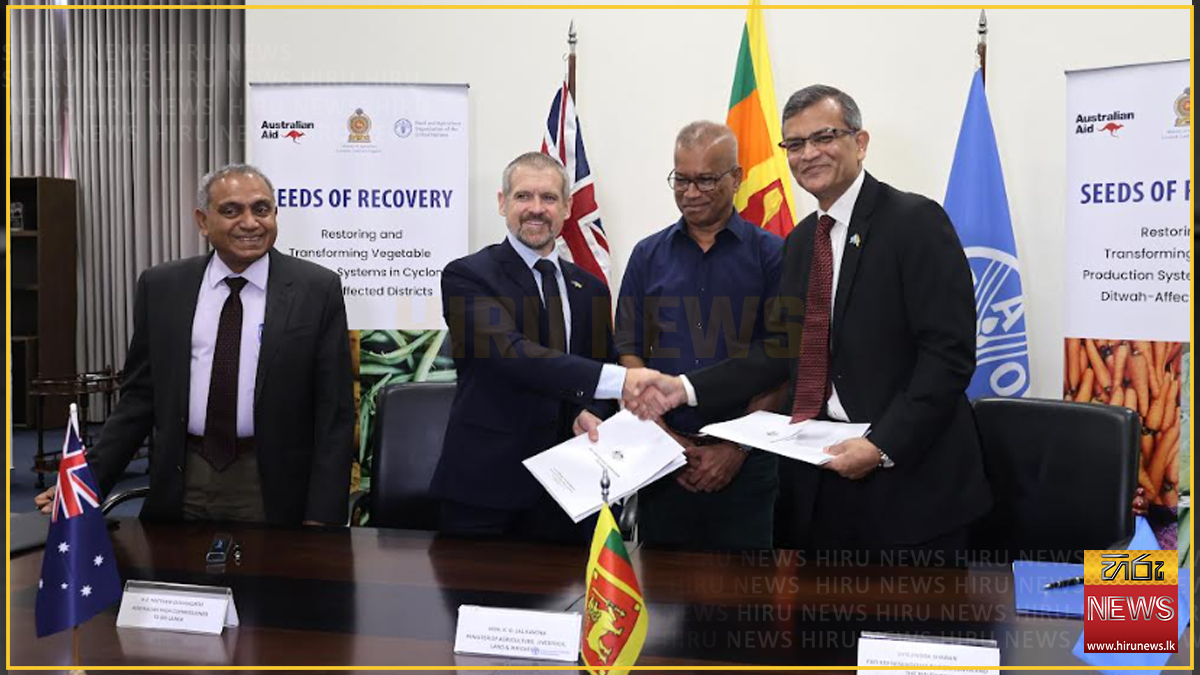


The Ministry of Agriculture, Livestock, Lands and Irrigation, the Government of Australia, and the Food and Agriculture Organization of the United Nations (FAO) marked the launch of a AUD 2 million (USD 1.4 million) recovery initiative to restore and transform vegetable production systems in the cyclone-affected districts of Nuwara Eliya and Badulla.
The agreement was formalized through the signing of the grant agreement by Matthew Duckworth, Australian High Commissioner to Sri Lanka, and Vimlendra Sharan, FAO Representative for Sri Lanka and the Maldives, alongside the signing of the project document by D. P. Wickramasinghe, Secretary of Agriculture, and Sharan.
Cyclone Ditwah, which struck Sri Lanka in November 2025, caused widespread devastation across the country, severely disrupting agricultural production systems and livelihoods. The highland districts of Nuwara Eliya and Badulla, key suppliers of vegetables such as beans, carrots, leeks, cabbage, tomato and potato, were among the hardest hit, with thousands of smallholder farmers losing crops, seed stocks, and productive assets.
This 12-month initiative aims to restore and strengthen climate-resilient vegetable production systems, with a strong focus on empowering women farmers and supporting persons with disabilities. The project will directly benefit more than 2,400 smallholder farmers, through improved seed and seedling production systems, small machinery, training, and market linkages while indirectly supporting thousands more.
“This initiative is an important step not only in restoring what was lost, but in building a more resilient and self-reliant agricultural sector,” said Minister Lal Kantha. “By strengthening local seed systems and supporting smallholder farmers, particularly women and vulnerable groups, we are investing in the long-term sustainability of Sri Lanka’s food systems.”
“Australia stands alongside Sri Lanka in its ongoing recovery from Cyclone Ditwah,” said High Commissioner Duckworth. “Australia is a steadfast partner in the agriculture sector with its importance for food security, rural development and climate resilience. By focusing on climate smart practices, farmer-led solutions and inclusive economic opportunities, this project will deliver meaningful and lasting benefits to affected communities
The project will prioritize the restoration of farmer-led seed systems for beans and potatoes, support the re-establishment of both open-field and protected cultivation systems and women led seedling supply nurseries while empowering all farmers with Climate-Smart Good Agricultural Practices (CSGAP) with small scale machinery and input support.
Latest News
Colorado firebomb suspect to plead guilty to all state charges

Ukraine tried to attack Russia's Kirishi oil refinery

Putin and Zelensky proclaim rival ceasefires for Victory day celebrations

Russia limits mobile internet ahead of WW2 victory parade

How an ocean cruise turned into a hantavirus nightmare

Airport taxi operators flag service disruptions and layoffs, seek temporary relief

Police constable remanded for accepting bribe

Government agrees to debate on USD 2.5 million Treasury heist

M K Stalin tenders resignation as Tamil Nadu chief minister

People’s Bank wins ‘Sri Lanka’s Best Asian Bank 2026’ award